Stop Shrinking Clothes: Care Labels Explained in 5 Symbol Groups
A care label is the manufacturer’s instruction sheet for keeping a garment intact, sewn right into the seam. It breaks down into five symbol groups: washing, bleaching, drying, ironing, and professional cleaning. The rule that covers almost every situation is simple: follow what the symbols say, and when a symbol is ambiguous or damaged, default to the gentlest option available.
TL;DR:Following washing symbols precisely prevents shrinking, bleeding, or fabric damage, especially when adjusting cycles based on the number of agitation bars.
Drying symbols warn that high heat can warp or melt fibers, making air drying or flat drying in shade the safest options for delicate or synthetic fabrics.
Bleaching symbols indicate that oxygen-based bleach is safer for most garments, while chlorinated bleach should only be used if the label allows it.
Ironing instructions vary by dot level, with some fabrics requiring low heat or no iron at all, and steam should be avoided on certain delicate textiles.
Professionally cleaned garments need specific solvent settings or gentle processes, with labels informing cleaners of the proper method to avoid damage.
Clothme
Find Sizes That Fit Your Family
ClothME creates personalized size profiles from two photos, helping families shop for clothing sizes without guesswork across brands.
Explore ClothME
Table of Contents
Care Labels Explained: Decoding the Washing Symbols
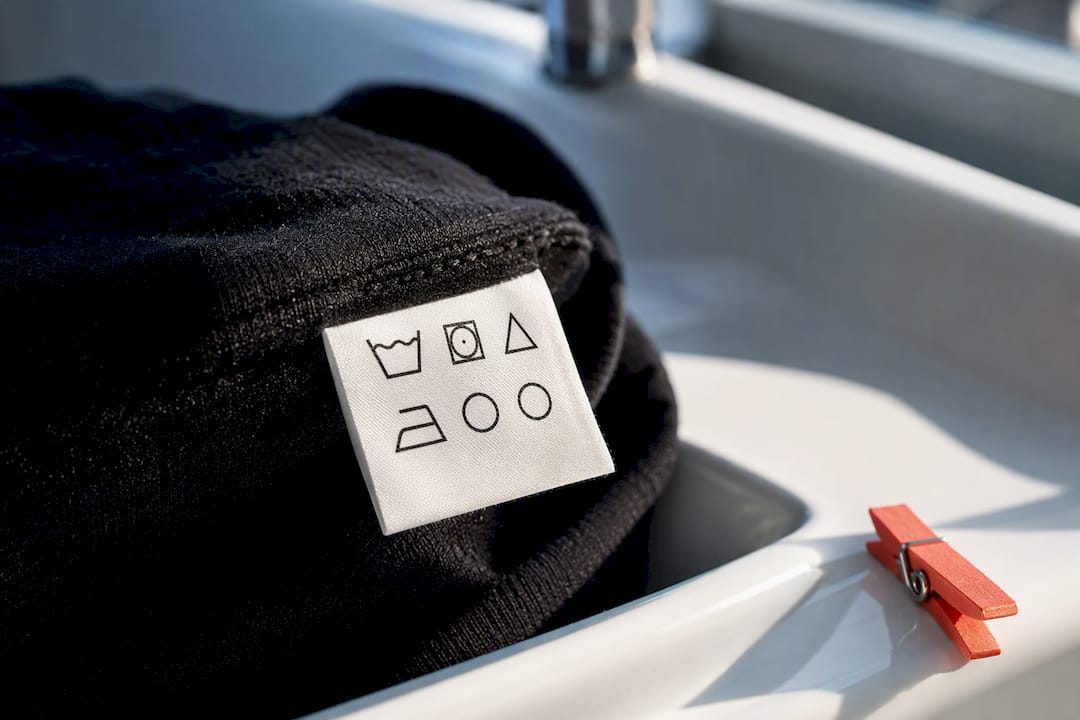
The washing symbol is a tub. A plain tub means machine wash. A tub with a hand inside it means hand wash only, and a crossed-out tub means don’t wash it at all, ever, in any machine or sink.
Temperature shows up two ways depending on where the garment was made. American labels often use dots inside the tub, where one dot means cold, and higher dot counts step up through warm and hot. European and many imported labels use a number instead, showing the maximum safe temperature in Celsius, like 30, 40, or 60. Both systems point at the same thing: how much heat the fibers can take before they shrink, bleed color, or warp.
Bars underneath the tub control agitation, not heat. No bar means a normal cycle. One bar signals a permanent press or “gentle normal” cycle. Two bars means delicate or hand wash cycle, the mode that spins slower and swishes less. A knit sweater with a two bar symbol wants that slow tumble, not the standard cycle your jeans get.
Plain tub: machine wash on a normal cycle.
Tub with one bar: use the permanent press setting.
Tub with two bars: switch to delicate or hand wash mode.
Tub with a hand: wash by hand, or use a delicate machine cycle with protection.
Crossed-out tub: skip washing entirely, dry clean instead if the label allows it.
Pro Tip: A high-end washer’s “hand wash” or “delicate” setting can often stand in for actual hand washing if you zip the garment into a mesh laundry bag first. Save true hand washing for anything irreplaceable, like a wedding dress or a hand-knit heirloom.
What Do the Drying Symbols Mean?
A circle inside a square is the tumble dry symbol, and dots inside that circle control heat the same way they do for washing: one dot for low heat, two for normal, three (less common) for high. A crossed-out dryer means air dry only, full stop, because heat will shrink, melt, or warp that fabric.
The plain square by itself, without a circle, means air dry, and the details inside it tell you exactly how. A horizontal line through the square means line dry, hanging it up. Three vertical lines mean drip dry, meaning don’t wring it out first. A curved shape means dry flat, laid out on a towel so gravity doesn’t stretch it. A diagonal line in the corner of any drying square means dry in the shade, which matters for anything prone to fading.
Circle in square, one dot: tumble dry low.
Circle in square, crossed out: never put it in the dryer.
Plain square with a curve: lay flat to dry.
Plain square with a diagonal line: dry out of direct sunlight.
Quick rule of thumb: synthetics and anything with elastane want low heat or air drying. Knits almost always want to dry flat so they don’t stretch out of shape. Bright or dark colors do best drying in shade, away from UV fading.
Bleaching Symbols: When Is It Safe to Use Bleach?
A plain triangle means any bleach is fine, including chlorine bleach. A triangle with two diagonal lines inside it means non-chlorine bleach only, the oxygen-based kind. A triangle with an X through it means don’t bleach at all, in any form.
Older labels sometimes printed the letters “CL” inside the triangle as shorthand for chlorine bleach, but that convention has mostly faded out in favor of the plain triangle. Modern labels rely on the symbol system rather than lettering.
If your label restricts bleach, or you’re not sure what’s safe, an oxygen-based stain remover is the safer default over chlorine bleach almost every time. Always spot-test on an inside seam first and wait a few minutes to check for color change before treating the whole stain.
Plain triangle: any bleach works.
Triangle with two lines: non-chlorine bleach only.
Crossed-out triangle: no bleach, period.
Ironing Symbols and Steam Rules
The iron symbol uses dots the same logic as washing and drying: one dot means low heat (synthetics, silk), two dots means medium heat (wool, polyester blends), and three dots means high heat (cotton, linen). A crossed-out iron means don’t iron this at all, which usually shows up on anything with sequins, foil printing, or heat-sensitive coating.
Steam gets its own marking. Lines coming off the iron symbol mean steam is fine. An X through those lines, or through the whole symbol, means no steam, because moisture combined with heat can cause puckering or watermarking on certain fabrics.
Pro Tip: Iron delicate trims, appliqués, or metallic prints from the inside out, and lay a thin cotton cloth between the iron and the fabric as a buffer. It’s cheap insurance against scorch marks and shine.
One dot: low heat, use for silk or synthetics.
Two dots: medium heat, safe for wool blends.
Three dots: high heat, fine for cotton and linen.
Crossed-out iron: skip ironing entirely.
Professional Cleaning Symbols: What Does the Circle Mean?
A circle means the garment needs professional cleaning, not a home wash. The letter inside tells the cleaner which solvent or process to use: P means a standard dry cleaning solvent, F is a less common alternative solvent, and W means professional wet cleaning, a controlled machine process that’s gentler than a home wash but still counts as a specialty service.
Bars under the circle work exactly like they do under the wash tub: they call for a gentler cycle at the cleaner, with less mechanical action and lower heat.
A crossed-out circle means don’t attempt any professional cleaning process at all, which is rare but shows up on some coated or bonded fabrics. If your label shows a circle with a letter, hand that information straight to your cleaner rather than guessing at a home fix. Anything with structured tailoring, beading, or a bonded lining belongs at the cleaner, not in your washer.
Circle with P: standard dry cleaning solvent.
Circle with W: professional wet cleaning process.
Circle with a bar underneath: request the gentle cycle.
Crossed-out circle: no professional cleaning of any kind.
How Do You Actually Read a Care Label Step by Step?
Reading a tag takes thirty seconds once you know the order symbols usually appear in: wash, bleach, dry, iron, then professional cleaning. Check each one for a bar, dot, or cross before you touch the laundry.
Read all five symbols left to right and note any bars, dots, or crosses attached to them.
Run a quick colorfastness check on colored items: dab a damp white cloth on an inside seam and see if color transfers.
Load delicates into a mesh bag and pick the gentlest cycle the tub symbol allows.
Photograph the tag before you cut it off, so you have a record if the garment shows problems later.
That last step matters more than people think. Documenting the care instructions you followed gives you real leverage if a garment fails under recommended care: it becomes the retailer’s problem to fix, not yours to explain away.
Why Care Labels Matter: The Legal and Testing Side
Care labels aren’t marketing copy. In the United States, the FTC Care Labeling Rule (16 CFR Part 423) requires manufacturers to attach a permanent, legible label listing at least one safe method for cleaning the garment, and that label has to survive the life of the product, not just the first wash.
Manufacturers need what regulators call a “reasonable basis” for the instructions, meaning actual testing on the finished garment rather than a guess based on the fabric alone. A cotton shirt with a fused interlining or metal buttons often carries a more conservative care instruction than the shirting fabric would need on its own, because the finished garment’s trims determine the limits, not just the yardage.
A single listed safe method doesn’t mean every other method is unsafe. It means the manufacturer tested and stands behind that one path, and following it protects your claim if the garment fails.
That distinction is why accurate labels reduce returns: when instructions match what the fabric can actually survive, fewer garments come back damaged and disputed.
The Care Label Cheat Sheet You Can Screenshot
Symbol group One-line rule Washing (tub) Match the dot/number to temperature; bars mean gentler cycle Bleaching (triangle) Plain = any bleach, lines = oxygen only, X = no bleach Drying (square) Circle inside = dryer; heat dots apply; plain square = air dry Ironing (iron) Dots set heat; crossed lines mean skip steam Professional clean (circle) Letter sets solvent; bar means gentle process only
When a symbol looks unclear or half worn off, default to the gentlest reading: cold water, low heat, no bleach, air dry.
Reading the Fiber Content Tags Next to the Symbols
Care symbols usually share space with a fiber content line, and that text changes how much weight you should give the symbols. Common abbreviations include CO for cotton, PES or PET for polyester, WO for wool, PA for nylon (polyamide), EL or SP for elastane/spandex, and VI for viscose/rayon.
A blend listed as “60% CO, 40% PES” behaves differently than either fiber alone. Cotton wants more heat tolerance; polyester wants less. The symbol on the tag already accounts for that mix, which is exactly why the most conservative fiber in a blend usually sets the ceiling for wash temperature and dryer heat. Wool blends are the trickiest: even a small percentage of wool in a blend can justify a cold wash and flat dry instruction that a pure cotton version of the same shirt wouldn’t need.
If you’re shopping and comparing two similar-looking garments, the fiber content line is often more informative than the cut or price tag. A 100% cotton tee and a cotton-poly blend tee can carry nearly identical care symbols but age very differently over two years of washing, with the blend usually holding its shape longer and the pure cotton softening and shrinking more.
Common Mistakes People Make Reading Care Tags
The most common mistake is treating the hottest allowed setting as the recommended one. A “40°C max” symbol means don’t exceed 40, not “wash at 40 for best results.” Cooler is almost always safer for color and fiber integrity.
Another frequent error: assuming a crossed-out symbol applies to the whole care routine instead of just that one process. A crossed-out iron doesn’t mean don’t wash the garment, and a crossed-out bleach triangle doesn’t mean don’t dry it in the dryer. Each symbol governs only its own process.
People also confuse “dry clean” recommended with “dry clean” required. Some labels list dry cleaning as one safe option among others, not the only option. Check whether a wash tub symbol also appears on the tag; if it does, home washing is fine too.
Finally, a lot of shoppers skip the bars and dots entirely and just glance at the base shape. That’s how a delicate sweater ends up shrunk two sizes: the tub symbol looked like “machine washable,” but the two bars underneath were calling for the gentle cycle nobody selected.
What to Do When the Care Label Is Missing or Damaged
A missing or unreadable tag doesn’t mean you’re stuck guessing. Start with the fiber content, if any part of the label survived, since fiber often dictates the safest general approach: natural fibers like cotton and linen tolerate more heat, while wool, silk, and synthetics with elastane need cooler, gentler handling.
When there’s truly no information left, treat the garment like its most fragile plausible fiber. Wash it cold, on a delicate cycle, inside a mesh bag, and air dry it flat rather than risking the dryer. That approach costs you a little convenience but protects against shrinkage or color loss you can’t undo.
For anything structured, beaded, or lined, a dry cleaner can often identify fiber content and recommend a safe process even without a label, since professional cleaners routinely handle unlabeled vintage and couture pieces. It’s worth the short conversation before you run it through a home wash.
One more note on delicate accessories that ride along with clothing but aren’t textile at all: metal trims, buttons, and jewelry need their own care logic entirely separate from fabric symbols. If you’re wondering whether a plated clasp or button will hold up over time the way solid metal does, comparing tarnish-resistant versus plated finishes is a useful parallel to how fabric care symbols work: the base material sets the ceiling for how much handling it can take.
A Personal Note on Why This Actually Matters
I’ve saved a favorite sweater from the donation pile more than once just by finally reading the little tag I’d ignored for a year. It wasn’t complicated. It was one dot, one bar, and a decision to use cold water instead of warm.
Garments that get the care their label actually asks for hold their shape and size longer, which matters more for fit than most people realize. A shirt that shrinks a size after bad laundering isn’t a sizing problem, it’s a care problem.
— admin
Buy Fewer Clothes That Fail You in the First Place
Care labels only protect a garment that fit well to begin with. A shirt bought a size too small because of inconsistent brand sizing is going to end up in the return pile no matter how carefully you wash it, and that gap between correct sizing and correct care is exactly where most wardrobe frustration starts.
Clothme fixes the sizing half of that equation. Upload two photos, get a size profile built around your actual body shape, and browse only the pieces that will genuinely fit, in the fabrics and colors you already reach for. Save profiles for your family members, too, so nobody in the house is stuck guessing at a brand’s inconsistent size chart. Pair a garment that fits right with the care instructions on its tag, and it lasts. Fewer returns, fewer things pushed to the back of the closet after one wash gone wrong, more clothes that stay in rotation instead of piling up as unresolved returns. If you’re tired of ordering three sizes to keep one, build your size profile at Clothme and start browsing what actually fits.