Measure Your Inseam in 10 Minutes for Pants and Bikes
Your inseam is the length of your inner leg, measured from your crotch to your ankle. The fastest reliable way to check it: stand barefoot against a wall, press a hardcover book firmly into your crotch, and measure from the top edge of the book down to the floor. Record that number in inches, since it drives everything from jean length to bike frame size.
TL;DR:Measuring your inseam in the evening avoids errors caused by spinal compression and better reflects how clothes will fit later in the day.
Using the book-between-legs method with a helper ensures consistent results, especially for cycling or tailoring, by replicating actual waistband placement.
Repeating the measurement three times and averaging eliminates inaccuracies caused by posture shifts or tape sagging, leading to more reliable sizing.
Your inseam varies by brand, fabric, and country, so always cross-reference your measurements with specific brand sizing charts before purchasing.
Save multiple inseam measurements for flats, heels, and cropped styles, and use tools like ClothME to store and apply the correct profile to prevent fitting mistakes.
Table of Contents
Style and shoe adjustments: how your look changes the number
Save your inseam once with ClothME and stop reordering pants
How to measure your inseam on your body
You need three things: a soft tape measure, a hardcover book (or a flat level), and ideally a second person to help. A wall and a bare floor round out the setup. Skip the socks and shoes unless you’re specifically checking fit with heels on, which gets its own math later.
Here’s the sequence that gets you a number you can trust:
Stand with your back flat against a wall, feet together, posture natural, not stretched tall.
Press the spine of the book between your legs and pull it up snugly against your crotch, mimicking where a waistband actually sits.
Keep the book level and have your helper measure straight down from the top edge of the book to the floor.
Write down the number, then repeat the whole process two more times and average the results.
The book-between-the-legs method beats using your hand or a rough estimate because it recreates the natural seat point of a pair of pants far more consistently. Cyclists should record the number in centimeters as well as inches; clothing shoppers only need inches. Repeating the measurement two or three times and averaging removes the small errors that creep in from posture shifts or a tape that’s not quite straight.
Pro Tip: Do this measurement in the evening rather than first thing in the morning. Spinal compression during the day can shift your reading by a few millimeters, and evening measurements tend to match how your pants actually fit later in the day.
Measuring inseam from a pair of pants that already fits
If you already own a pair of pants that fits the way you want, this is the quicker route, no book, no helper, no standing around.
Pick a pair that matches the style you’re shopping for. Don’t measure cropped trousers if you’re trying to buy full-length jeans.
Lay the pants flat on a table or floor, smooth out the fabric, and align both legs so there’s no twist in the seam.
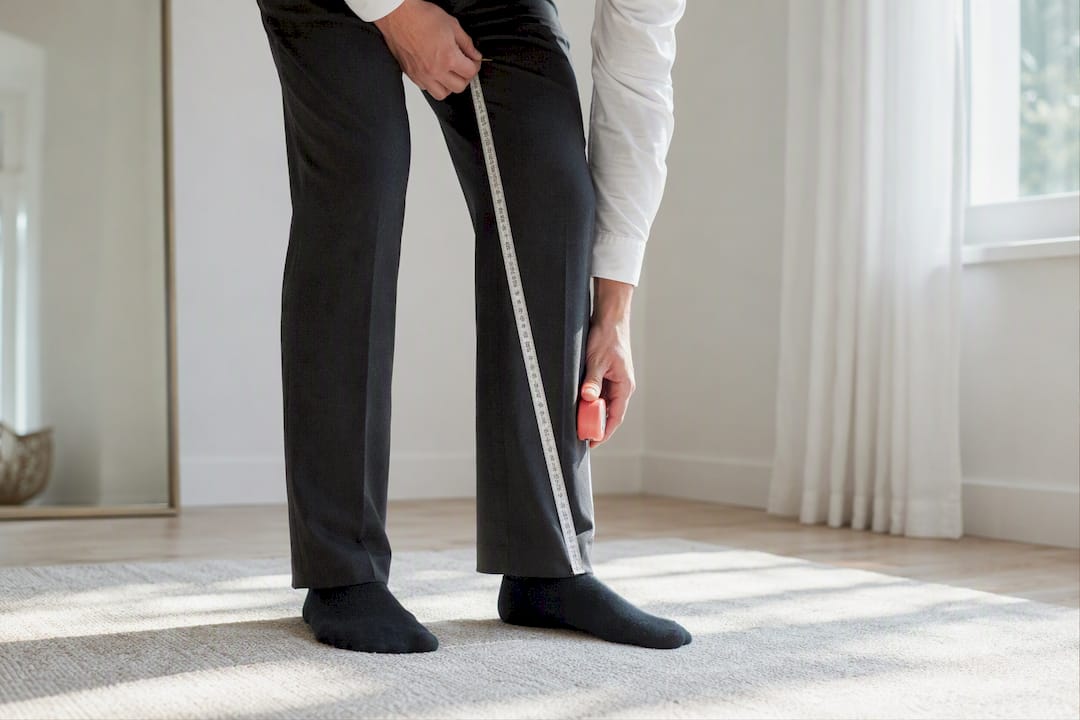
Measure from the crotch seam straight down the inside leg to the bottom hem, keeping the tape flush against the fabric rather than letting it float.
Measure the pants after they’ve been washed, not before, because denim and heavy cotton can shrink after the first laundry cycle and throw your number off by close to an inch.
Check the tag. Most brands print sizing as waist by inseam (for example, 32x30), which gives you a built-in reference point for future purchases.
Jot the result down somewhere you’ll actually find it again. If you shop for jeans often, a dedicated inseam guide for denim walks through fabric-specific quirks worth knowing.
Measuring inseam for bike sizing: what’s different
Bike fitting uses a different inseam than clothing shopping does, and mixing the two up is a common way to end up on the wrong frame. Cyclists measure crotch-to-floor in centimeters while wearing cycling shorts, not the loose fabric of jeans, because the tighter fit changes where the tape sits.
Wear the shorts or bibs you actually ride in, then use the same book-between-legs technique against a wall.
Measure in centimeters, since nearly every frame-size chart and stack-height calculator is built around metric numbers.
Repeat the measurement two or three times and average it, same as the clothing method.
Treat this number as general direction for frame size, not a replacement for a proper bike-shop fitting.
A few centimeters of difference here can shift you into a different frame size, so don’t reuse an old jeans-inseam number for a bike purchase.
Style and shoe adjustments: how your look changes the number
Your raw inseam measurement is the starting point, not the final purchase number. What you plan to wear on your feet, and the cut you’re buying, both shift the math.
Heels: add roughly 0.5 to 2 inches depending on heel height, more for stilettos, less for a low block heel.
Skinny or slim fits: subtract about an inch from your standard measurement, since the leg opening sits differently.
Flares or wide-leg pants: add 1 to 2 inches so the hem still breaks correctly over the shoe.
Cropped or ankle styles: aim for 1 to 3 inches shorter than your full-length number, depending on how much ankle you want showing.
Pro Tip: Keep a running list of labeled inseam numbers, flats, heels, cropped, on your phone. You’ll stop guessing every time you shop for a new style.
Common mistakes and quick fixes
Small errors here compound into pants that never quite fit right.
Confusing outseam with inseam. Outseam runs from your waist to the floor along the outside of your leg; inseam only measures the inner leg. Mixing them up gives you a number several inches too long.
Measuring with shoes on. Unless you’re deliberately checking fit for heels, always measure barefoot.
Letting the tape curve or sag. A curved tape adds fake length; keep it taut and flat against the leg or fabric.
Slouching or standing unevenly. Poor posture skews the reading by an inch or more.
Getting different numbers on each leg. Average the two and note the gap. If the difference runs past half an inch, a tailor can adjust each leg separately rather than splitting the difference blind.
Quick inseam guideline ranges by height
These ranges work only as a fallback when you can’t measure right now, not as a substitute for the real thing.
5’0" to 5’3": cropped around 25–27", full-length around 27–29"
5’4" to 5’7": cropped around 27–29", full-length around 29–31"
5’8" and taller: cropped around 29–31 inches, full-length around the expected range for people 5’8" and taller
Body proportions vary enough between people of the same height that these bands are a rough starting point at best, never a substitute for the book-and-wall method. Add half an inch to a full inch to any of these ranges if you plan to wear the pants with heels.
How to record, save, and reuse your inseam
Save separate numbers for flats, heels, and cropped styles rather than one generic figure, since a single “inseam” doesn’t cover every scenario you shop for. A fit profile through ClothME stores those labeled measurements and applies them automatically when you browse, which cuts down on returns from guessed sizing. For a broader measurement checklist beyond inseam, our guide to measuring accurately for apparel fit covers the rest of your body too.
How inseam length varies by brand and country
A 30-inch inseam at one retailer can land closer to 28 or 32 inches at another, because there’s no single legal or industry standard forcing brands to size the same way. Vanity sizing plays a role here, some brands run their numbers generous on purpose, while others cut closer to true measurements. Fabric choice matters too: a stretch-cotton chino behaves differently than raw denim, even when both are tagged with the same inseam number.
Country of origin adds another layer. European brands frequently size pants using centimeters translated into approximate inch equivalents, and the rounding in that conversion introduces small inconsistencies. A pair labeled 76 cm might round to a 30-inch tag at one company and a 29.5-inch tag at another. Japanese and Korean brands often run shorter in the rise and inseam relative to American sizing charts, which trips up shoppers who assume their usual American number will transfer directly.
The safest habit is treating every brand’s size chart as its own system rather than assuming consistency across labels. Check the specific garment’s measurements, listed in inches or centimeters on most product pages, against your own recorded inseam before buying. This is exactly why relying on a single “my inseam is 30” mental note falls short: what you actually need is your raw body measurement, cross-referenced against each brand’s own chart every time you shop somewhere new. Keeping your true inseam on file, rather than a size number from one specific store, protects you from this brand-to-brand drift entirely.
How to adjust for tailoring and alterations
Once you know your body’s true inseam, hemming becomes a straightforward subtraction problem. If your inseam measures 30 inches and you want your pants to break right at the top of your shoe, ask a tailor for a finished inseam close to that number, adjusted slightly for the shoe you’ll wear most often with that pair.
For a no-break look popular with slimmer trousers, tailors typically shorten the finished length to sit just above the top of the shoe, often half an inch to an inch shorter than your raw measurement. A slight break, where the fabric folds gently over the shoe, usually lands right at your true inseam number or up to half an inch longer.
Bring your own measurement to the tailor rather than relying on the pants’ current length as the baseline, especially if you bought the pants unhemmed or a size up. Tailors work from the finished garment on your body, marking the new hem while you’re wearing the shoes you intend to pair with it, since that’s the only way to account for heel height accurately. If you’re altering multiple pairs at once, hand over your labeled measurements for flats and heels separately so the tailor doesn’t have to guess which version you want for which shoe. A basic hem adjustment is inexpensive at most tailoring shops, but bigger changes, like recutting the rise or adjusting where the crotch seam sits, run higher and are worth confirming in cost before committing.
Why getting this number right actually matters
A friend of mine reordered the same pair of jeans three times in two sizes before she finally measured with a book against the wall. Ten minutes, and she never guessed again. Measure once, write it down, and you’ll save yourself the same round of returns.
— admin
Save your inseam once with ClothME and stop reordering pants
ClothME is the practical next step after you’ve done the measuring work above. Instead of re-measuring every time you shop, or gambling on a brand’s size chart, you upload two photos once and build a size profile that remembers your exact inseam, flats, heels, cropped versions included.
Parents shopping for growing kids know this pain best: sizes shift every few months, and guessing wrong means a return shipment nobody has time for. ClothME lets you save a profile for each family member, so shopping for your kid’s next pair of jeans doesn’t start from zero. The platform then filters what you see to items that actually match your saved measurements, style preferences, and fabric choices, cutting down the back-and-forth of ordering three sizes to find one that works. For readers who want the fuller mechanics of garment measurement, key vertical and horizontal garment measurements is a solid technical primer worth a look.
Head to ClothME and set up your first fit profile with the inseam number you just measured. It takes less time than trying on a second pair of jeans.
Sources
The core methods here come from wikiHow’s leg-length measurement guide and its companion inseam guide, along with HowToMeasureIt’s notes on fabric shrinkage and We Love Cycling’s bike-fit sizing piece. For deeper reading on pants specifically, see ClothME’s full inseam measurement guide.