Types of Couple Fashion Coordination: 2026 Style Guide
Couple fashion coordination is defined as the practice of creating cohesive, intentional outfits together while preserving each partner’s personal style. The five main types of couple fashion coordination are identical outfits, complementary color schemes, shared patterns, themed or aesthetic coordination, and neutral accent coordination. Each type serves a different purpose, from bold visual statements at events to subtle daily wear harmony. Knowing which approach fits your relationship’s style and the occasion makes the difference between looking polished and looking like you tried too hard.
1. What are the types of couple fashion coordination?
Couple coordination styles fall into five clear categories, each built on different principles of color, pattern, and aesthetic alignment. The five types are identical matching, complementary color coordination, shared pattern coordination, themed or aesthetic coordination, and neutral accent coordination. Each type works best in specific settings, and most couples naturally gravitate toward one or two of them. Understanding all five gives you real flexibility across casual outings, formal events, and travel.
2. Identical outfit coordination: when matching exactly works
Identical outfit coordination means both partners wear the exact same item or set, whether that is matching graphic tees, coordinated pajama sets, or identical streetwear pieces. This style makes the strongest visual statement and works best for themed events, casual loungewear, or intentional bold looks. The risk is real: identical outfits can look like uniforms or costumes when the fit or quality is poor.
The key to pulling off identical coordination is quality and fit. A matching set in a premium fabric with tailored proportions reads as intentional fashion. The same set in a cheap material with poor fit reads as a Halloween costume.
Best occasions for identical coordination:
- Themed parties or costume events
- Matching pajamas or loungewear at home
- Bold streetwear looks for festivals or concerts
- Holiday or family photo shoots
Pro Tip: When wearing identical pieces, let accessories and shoes differ between partners. This small variation preserves individuality and prevents the uniform effect.
3. How complementary color coordination enhances couple style
Complementary color coordination is the most versatile and widely used method in couple style matching. It uses color theory principles, specifically monochromatic, complementary, analogous, and triadic color schemes, to create outfits that feel connected without being identical. This approach works for nearly every occasion, from casual dates to formal events.
The bridge color technique is the most practical modern strategy. One partner anchors their outfit in a neutral like charcoal, beige, or stone, and the other uses that same neutral as a secondary tone. Each partner then adds their own accent color for individuality. Classic combinations that consistently work include Navy + White, Olive + Beige, Caramel + White, and Red + Black.
One technical factor most couples overlook is Light Reflectance Value, or LRV. Pairing high-reflectance whites with matte blacks without a mid-tone creates harsh visual contrast in photos. Adding a gray, beige, or warm brown as a mid-tone balances the exposure and makes both partners look equally present in images.
Practical color palettes for couples:
Palette Partner 1 Partner 2 Best Setting Classic contrast Navy White Casual or smart casual Earth tones Olive Beige Outdoor or travel Warm neutrals Caramel Cream Date night or brunch Bold statement Red Black Evening events
Pro Tip: Limit your shared palette to 2–3 colors maximum. More than three colors creates visual noise and breaks the cohesive effect you are building.
4. What role do shared patterns and prints play in couple coordination?
Shared pattern coordination means both partners wear the same print, such as plaid, stripes, or florals, but in different scales, colors, or item types. This approach creates visual interest without the rigidity of identical matching. Varying the print scale between partners is the key technique that prevents overmatching.
For example, one partner wears a large-scale plaid flannel shirt while the other wears a small-scale plaid accessory or lining detail. The shared pattern creates a visual connection. The scale difference keeps each person looking like an individual.
Popular patterns and how to use them as a couple:
- Plaid and flannel: Works well for fall outings and casual weekends. Vary the scale and color tone between partners.
- Stripes: A classic that reads as coordinated without being obvious. Mix horizontal and vertical orientations for variety.
- Florals: Best for spring and summer. One partner wears a bold floral print while the other wears a solid pulled from the print’s color palette.
- Geometric prints: Strong for creative photo shoots. Keep one partner in the print and one in a coordinating solid.
Combining shared patterns with complementary colors adds another layer of coordination. If both partners wear stripes but in navy and white respectively, the result is cohesive and sophisticated rather than costume-like.
5. How themed or aesthetic coordination expresses couple identity
Themed coordination moves beyond matching colors or prints. It aligns both partners within a shared fashion aesthetic, such as Dark Academia, 90s grunge, minimalism, or coastal preppy. This type of coordination requires strong mutual fashion tastes and a shared understanding of the aesthetic’s rules.
The South Korean concept of the couple look, known as “keo-peul-look,” captures this idea well. It emphasizes creative bonding through a shared visual identity rather than just following a trend. Couples who do this well are not matching outfits. They are expressing a shared worldview through clothing.
How to develop a shared aesthetic:
- Identify 3–5 fashion references you both respond to, such as specific films, decades, or designers.
- Build a shared mood board and identify recurring colors, silhouettes, and textures.
- Start with one aesthetic element, like a shared color palette or silhouette preference, before committing to a full look.
- Let each partner interpret the aesthetic through their own wardrobe strengths.
Themed coordination works best for couples with confidence in their personal style. It is the most creative and expressive type, but it requires the most intentional effort to execute well.
6. Practical tips for everyday coordinated couple outfits
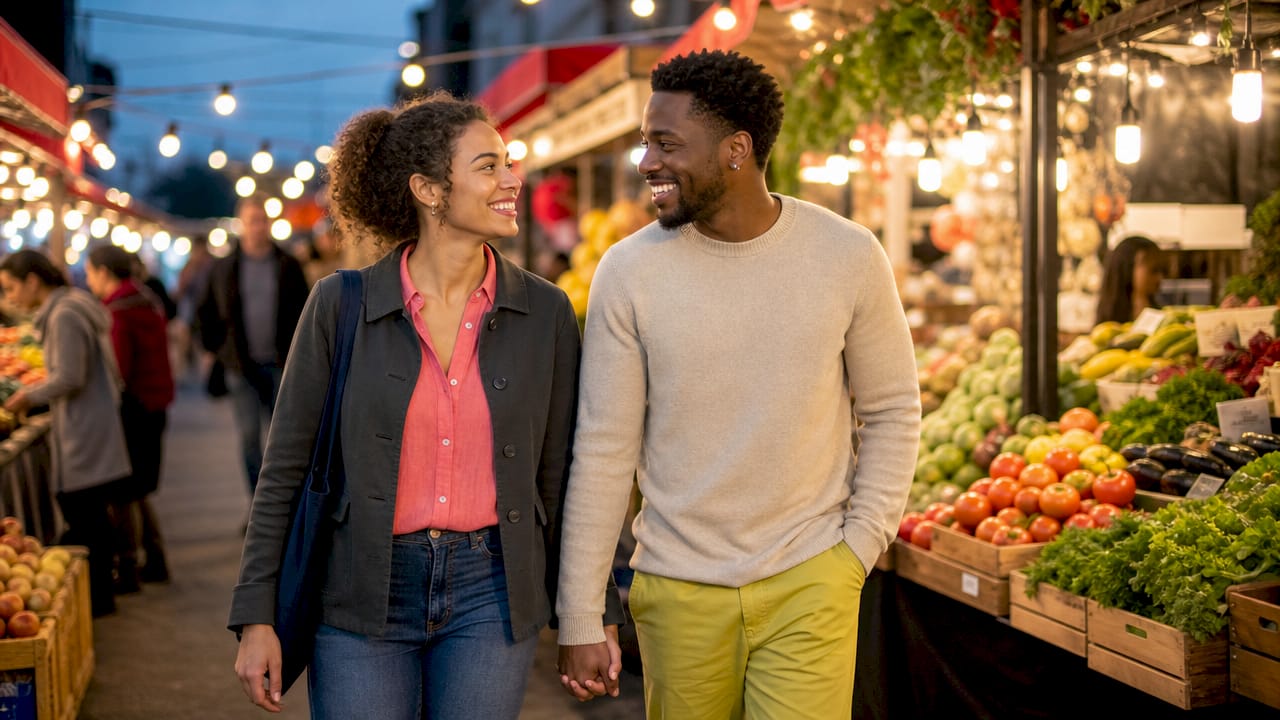
Everyday coordination works best through the neutral accent method. Each partner builds their outfit around a shared neutral color, then adds personal accent colors and pieces that reflect their individual style. Coordinating tones, textures, and vibes consistently produces more elevated results than matching exact items.
Matching the formality level between partners matters more than matching specific pieces. If one partner wears a blazer and the other wears a hoodie, the look reads as mismatched regardless of color coordination. Aligning the overall vibe, whether casual, smart casual, or formal, creates cohesion without effort.
For travel, a mini color palette of two neutrals and one accent color covers every outfit combination for the trip. Example palettes that work: Navy + White + Caramel, Beige + Cream + Olive, and Black + White + Red. This approach keeps packing light and keeps coordination consistent across multiple days and settings.
Everyday coordination strategies that work:
- Use accessories like matching watches, belts, or bag colors as subtle coordination anchors.
- Choose one shared color per outfit rather than trying to coordinate everything.
- For events, align silhouette formality first, then add color coordination as a second layer.
- Avoid coordinating every element. One shared detail is enough for a polished, connected look.
Pro Tip: Experts caution against uniform-like matching that erases individuality. A single shared color or accessory creates connection without making you look like a matching set.
Key takeaways
Coordinating outfits as a couple works best when you align formality and color first, then let individual style fill in the rest.
Point Details Five coordination types Identical, complementary color, shared pattern, themed, and neutral accent each serve different occasions. Color theory matters Use monochromatic, complementary, or analogous schemes and limit your palette to 2–3 colors. LRV affects photos Balance high-contrast outfits with a midtone neutral to avoid exposure issues in images. Formality alignment first Matching the vibe and formality level creates cohesion more effectively than matching exact items. Individuality preserves style Small differences in accessories or scale prevent the uniform effect and keep looks elevated.
Why coordination works best when you stay yourself
The couples who pull off coordinated outfits best are not the ones who match most precisely. They are the ones who have a clear sense of their own style and find the overlap with their partner’s. That overlap is where coordination lives.
I have seen couples spend hours trying to match exact shades and end up looking stiff and self-conscious. The ones who look effortless usually start with a shared color anchor and then dress normally from there. The coordination reads as natural because it is built on genuine style alignment, not forced matching.
The uniform trap is real. When both partners wear identical items without variation in fit, accessory, or texture, the look loses personality. A single shared element, whether a color, a pattern reference, or a silhouette choice, communicates connection without erasing the individual. That restraint is what separates stylish coordination from a matching costume.
My honest advice: start with color before anything else. Pick one color you both wear well and build outfits independently from there. When you come together, the connection will be visible without being obvious. That is the goal.
— admin
How ClothME makes couple coordination easier
Finding coordinated outfits that actually fit both partners is harder than it sounds, especially when sizing varies so much across brands. ClothME solves this directly.
ClothME lets each partner upload two photos to generate a personal size profile. The platform then surfaces only products that match each person’s body shape, style preferences, and color choices. For couples building a shared palette, this means both partners can shop within the same color range and see only pieces that will actually fit. No returns, no size guessing, and no mismatched formality levels. Visit Clothme to build your size profiles and start coordinating with confidence.
FAQ
What are the main types of couple fashion coordination?
The five main types are identical outfit coordination, complementary color coordination, shared pattern coordination, themed or aesthetic coordination, and neutral accent coordination. Each type suits different occasions and style preferences.
Is coordinating outfits better than matching exactly?
Coordinating tones and vibes consistently produces more elevated results than matching exact items. Exact matching risks looking like a costume, while coordination preserves individuality.
What is the bridge color technique in couple outfits?
The bridge color technique uses a shared neutral, such as beige, charcoal, or stone, as the base for both partners’ outfits. Each partner then adds their own accent color for personal style variation.
How do I avoid the uniform effect when coordinating outfits?
Vary accessories, shoes, or print scale between partners even when sharing a color or pattern. One point of difference is enough to keep both looks individual while maintaining the coordinated connection.
What color palettes work best for couples in photos?
Avoid pairing bright white with matte black without a midtone neutral, since the LRV contrast creates exposure issues. Palettes like Navy + White + Caramel or Beige + Cream + Olive photograph well and read as cohesive without harsh contrast.