US to EU Sizes: A Quick Conversion Guide for Shoppers
Add a number close to 33 to a US men’s size to estimate its EU equivalent; add around 31 to a US women’s size for a similar rough estimate. That works for a fast estimate, but it isn’t exact. If you want the right fit the first time, measure your foot in centimeters, heel to longest toe, and check it against the brand’s own size chart before you check out.
TL;DR:Rounding up to the next EU size is recommended when your foot length falls between two sizes, especially for half sizes or narrow fits.
Checking your foot length in centimeters against a brand’s specific size chart yields the most accurate fit, as size variations exist within the EU system.
Relying on country-specific EU size conversions can lead to mismatches because of different rounding habits and manufacturing tolerances across countries.
Using photo-based profiles from clothme.io can help avoid sizing errors, particularly for children, by directly matching foot proportions to available footwear.
Width fits vary significantly, so look for European brands that specify width options or size up half a size for wider feet to ensure comfort.
Table of Contents
US to EU Shoe Size Conversion Charts for Men, Women, and Kids
Foot length in centimeters is the one number that actually travels across borders. Sizes don’t, not reliably, because US and EU systems are built on different base units. Use the tables below as your starting point, then confirm against the specific brand whenever you can.
Men’s US to EU conversion
Women’s US to EU conversion
Kids’ US to EU conversion
US Kids EU Foot Length (cm) 10 27 16.5 — 28 17.1 12 30 18.1 13 31 18.7 1 32 19.4 2 33 20.0 3 34 20.6
These figures line up with the manufacturer-style lookup tables at AR Fit, which anchor every conversion to foot length rather than to a fixed number offset. When your foot length falls between two EU sizes, round up rather than down. Sizes run differently by brand, and a shoe cut narrow in the toe box will feel tighter than the chart suggests, even at the “correct” size.
How Do You Measure Your Foot for Shoe Sizing?
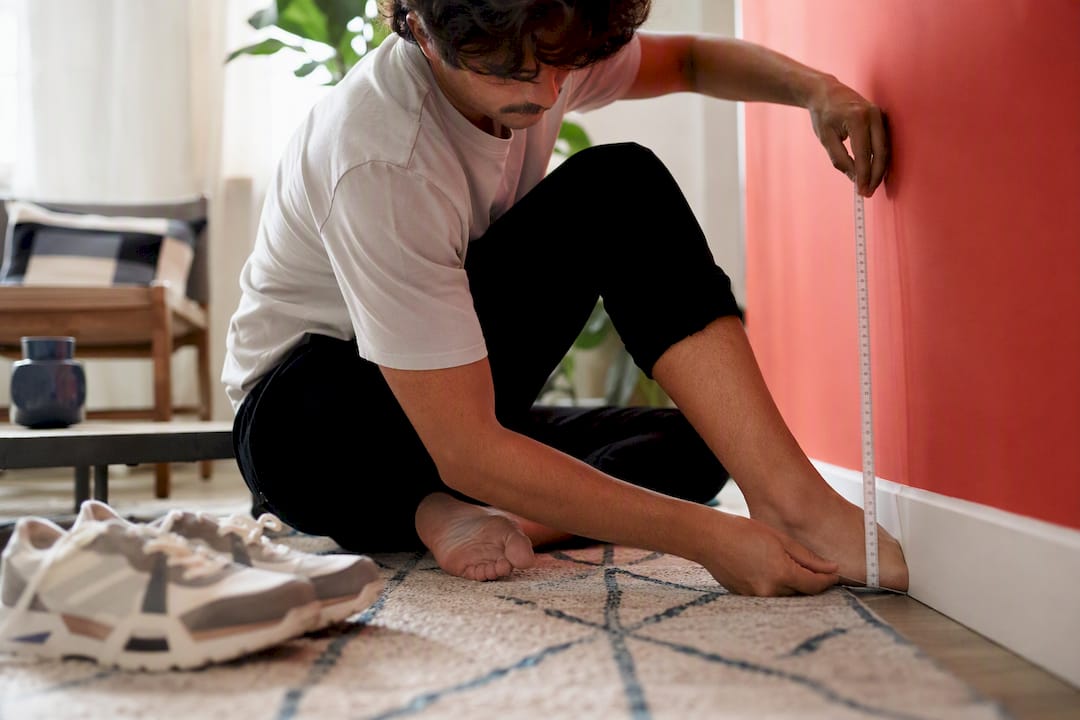
A tape measure and a piece of paper beat guesswork every time; for detailed steps, see how to measure for a wedding garter: your guide to the perfect fit. Here’s the method that gets you the most accurate number:
Place a sheet of paper on a hard floor, against a wall.
Stand on the paper with your full weight on that foot, heel touching the wall.
Mark the point where your longest toe ends (not always the big toe).
Measure the distance from the wall to the mark in centimeters or millimeters.
Repeat on the other foot. Most people have one foot slightly longer than the other, so use the longer measurement.
Add 5 to 10 mm of toe room for comfort and movement, then match that final number to the closest column in the tables above.
If you’d rather calculate than look it up, the EU size formula is roughly 1.5 × (length in cm + 1).
Pro Tip: Measure your feet in the evening. Feet swell slightly over the course of a day, and an evening measurement gives you a more realistic fit for all day wear.
Why Don’t US and EU Shoe Sizes Line Up Exactly?
The two systems were never built to match. The US scale moves in barleycorns, an old unit equal to about 8.47 mm per full size. The EU scale moves in Paris points, each one equal to two-thirds of a centimeter, or roughly 6.67 mm. That 1.8 mm gap per step compounds as sizes go up, which is exactly why a clean “add 33” rule works fine at a size 9 and starts drifting at a size 13.
There’s a second wrinkle: the US uses separate scales for men’s and women’s shoes, while the EU scale is unisex and based purely on foot length. A “US women’s 8” and a “US men’s 8” are not the same physical size, so their EU equivalents land in different places too. Add in the fact that every brand cuts its own last, the mold that shapes a shoe, and you get the half-size disagreements shoppers run into constantly. A generic conversion chart gets you close. A brand’s own millimeter-based chart, when it publishes one, gets you accurate.
Quick Rules for Ordering the Right EU Size
Once you know your foot length, ordering gets simple. A US women’s 8 lands close to EU 39, and a US men’s 9 lands close to EU 42.5. Those numbers hold up well in the middle of the size range and get less reliable at the extremes, so treat them as a fast check rather than gospel.
A few rules make ordering less risky:
If the retailer only stocks whole EU sizes and your foot falls on a half size, round up rather than down.
For growing kids, order one EU size larger than the chart suggests, since feet in the 6 to 10 age range grow roughly a centimeter a year.
For narrow, pointed, or dress styles, size up half a size regardless of what the chart says. The toe box shape matters more than the label.
When a shoe runs between two EU sizes and you can’t try it on, choose the larger one. A shoe that’s slightly loose is fixable with a thicker sock; a shoe that’s slightly tight isn’t.
Skip the Guesswork With Photo-Based Sizing
Charts and formulas get you close, but they still leave room for error, especially when you’re shopping for a child whose feet changed since the last pair. Clothme builds size profiles from two uploaded photos instead of a chart lookup, mapping your measured proportions directly to product listings so you see items that actually match your dimensions before you buy. You can save a profile for each family member, so ordering EU-labeled shoes for your kids doesn’t mean re-measuring every time a new pair catches their eye.
Pro Tip: Save your profile once, then check it against the brand’s stated foot length in centimeters before ordering EU-sized shoes. It cuts the return rate down to almost nothing.
Ordering Shoes From Different EU Countries
Not every country using the EU size scale applies it the same way. France, Germany, Italy, and Spain all publish sizes on the same Paris point system, but manufacturing tolerances and national labeling habits still create small gaps between them. A French size 40 dress shoe and a German size 40 hiking boot can differ by several millimeters in actual foot length, even though the label matches exactly.
The safest approach is to stop trusting the printed number alone and start checking the retailer’s own foot length chart, which most French and German shoe sites include somewhere in the product details or size guide. If a German brand lists 40 as fitting a 25.4 cm foot and a French brand lists 40 as fitting 25.7 cm, that’s not a mistake. It’s a real difference in how each country rounds its sizing.
When you’re ordering from multiple countries in the same shopping trip, don’t assume your “usual EU size” travels cleanly between them. Pull up your measured foot length in centimeters and match it against each site’s own chart individually. It takes an extra minute per order, but it’s the difference between a shoe that fits and one that gets shipped back. Reviews mentioning “runs small” or “runs large” on a specific retailer’s page are also worth a scan. They’re often a reflection of that country’s rounding habits more than a flaw in the shoe itself.
Don’t Ignore Width When Converting Sizes
Length gets all the attention in shoe sizing, but width causes just as many bad fits, and most US to EU charts don’t touch it at all. American shoes commonly come in width designations like B, D, and EE, while European shoes rarely list width at all. A shoe simply gets built on a wider or narrower last depending on the brand, with no letter on the box to warn you.
If you know you need a wide fit in US sizing, that information doesn’t convert automatically. Look for European brands that specifically advertise a roomier last or list a width option, often labeled with an “H” or “wide” tag on athletic and outdoor shoe lines. Absent that, sizing up half a size in length is the common workaround, though it changes how the shoe sits at the heel and can affect comfort during long wear.
Narrow feet run into the opposite problem: a shoe sized correctly in length can feel sloppy at the ankle and midfoot. Lacing adjustments and insoles help, but they’re a patch, not a fix. If you have a narrow or wide foot and you’re ordering from a European brand for the first time, read the product description closely, and don’t rely on the length conversion alone to guarantee a good fit.
What to Do When Your Size Has No Exact EU Match
Half sizes are the most common gap shoppers hit. A US men’s 9.5 or a US women’s 7.5 sometimes doesn’t have a listed EU equivalent on a given retailer’s site, particularly with European brands that only stock whole sizes. When that happens, round up. A slightly loose shoe is a solvable problem; a slightly tight one usually isn’t, especially in a material that doesn’t stretch.
Unusual US sizes cause a similar issue. Sizes above a men’s 13 or below a women’s 5 sometimes fall outside the range a European retailer stocks entirely, since sizing charts abroad don’t always extend as far in either direction. If your foot length in centimeters falls beyond what the chart offers, check whether the brand sells a wide or extended-size line separately, since those often use a different chart than the standard one.
When no EU size matches cleanly, foot length overrides the number every time. Order based on the centimeter measurement closest to your own, not the size label that seems familiar from past purchases. It’s a small mental shift, but it solves most of the “the size didn’t exist” problem before it starts.
What Actually Works When You Buy Shoes Across Borders
Rules of thumb get you in the right neighborhood, and that’s genuinely useful when you’re scanning a size chart mid checkout. But every shortcut in this guide breaks down at the edges of the size range, and no addition formula accounts for a narrow last or a brand that runs small. Measure your foot once, keep that number handy, and use it every time you shop instead of trusting whatever the label says.
— admin
Where to Verify a Size Before You Buy
For unit definitions and the history behind barleycorns and Paris points, Wikipedia’s shoe size entry is the clearest reference. For a working converter with foot length columns, use the Smart Calculators tool, or start a saved size profile at Clothme.
Let Clothme Build the Size Profile Your Charts Can’t
A chart gets you close. A profile built from your actual measurements gets you the right shoe the first time, which is the gap Clothme was built to close. Upload two photos, and Clothme generates a size profile that maps your real proportions against product listings, including EU-labeled footwear, instead of asking you to guess where your foot lands on someone else’s conversion table.
Parents shopping for kids benefit the most: save a profile for each child, and every future order pulls from measurements you already recorded instead of a new tape-measure session. If you’ve been burned by a shoe that looked right on the chart and fit wrong in the box, check the clothing size conversion chart for more background, then set up your family’s saved profiles at Clothme before your next order.