How Size Profiles Save Shopping Time for Families
Saved, photo-generated size profiles cut online shopping time by filtering out every item that won’t fit before you even start browsing. Instead of opening twelve product pages and cross-referencing a brand’s size chart against your measurements, you see a feed already sorted to your body. That’s the core mechanism, and it works for every family member you add.
Here’s what’s happening under the hood:
Feed filtering: Your profile hides SKUs that fall outside your fit range, so you page through far fewer items.
Decision confidence: Clear fit flags on product pages reduce the back-and-forth between listings, size charts, and reviews. Research links this kind of processing fluency directly to higher satisfaction and faster decisions.
Fewer returns: Accurate first-try sizing means you’re not re-ordering after a return, which is its own time cost.
Family switching: One session can cover multiple people without re-entering measurements each time.
Clothme uses photo-generated profiles to power all of this, with measurement accuracy that holds up against published benchmarks.
Key Takeaways
Saved photo-generated size profiles reduce shopping time by filtering product feeds, speeding decisions, and cutting returns, with the biggest gains for parents managing multiple family members.
Point Details Feed filtering saves the most time Profiles hide non-fitting SKUs before you browse, cutting scrolling and page-opening significantly. Accuracy is measurable Published tests report average measurement error under 3% and median error under 1 inch for core dimensions. Parents gain the most Growth-trajectory features let parents buy sizes that stay accurate for roughly 1–2 years; 95% of users in one survey rated kids’ sizing tools as helpful. Try-on still matters sometimes Tailored garments, formal wear, and unfamiliar brands with no product dimensions still warrant an in-person fit. Clothme covers the whole family Clothme saves photo-generated profiles for every family member and filters feeds by size, style, and fabric in one session.
Table of Contents
How size profiles save shopping time at every step
The time savings aren’t concentrated in one place. They compound across the whole session.
Filtering is the most obvious lever. When a saved profile removes non-fitting sizes from a product feed, you’re not scrolling past items that would never work. That alone cuts browsing time for a typical session.
SKU-level fit predictions go further than filtering by size label. Because sizing varies by brand and even by garment cut within a brand, a profile that maps your measurements to garment construction data gives you a more reliable signal than “Medium” ever could. AI-based fit models build probabilistic predictions from behavioral signals, visual inputs, and garment specs, and they get sharper over time as you keep or return items.
Decision confidence is where the cognitive savings show up. A product page that surfaces a clear “fits your profile” badge reduces the mental work of evaluating a garment. According to research on size recommendation systems, both algorithmic personalization and clear UI design matter for perceived usefulness. When the interface makes fit easy to read, shoppers decide faster and feel better about those decisions.
Checkout speed is the downstream payoff. Accurate sizing on the first order means you’re not tracking a return, waiting for a refund, and browsing again for a replacement. Randomized field experiments found that virtual-fit information increased conversion and order value while reducing fulfillment costs tied to returns.
Pro Tip: If a platform lets you mark items as “kept” or “returned,” do it consistently. That feedback loop sharpens fit predictions faster than any other input.
What does a photo-generated size profile actually need?
The inputs are minimal. Most platforms, including Clothme, ask for:
Two full-body photos (front and side view)
Your height
Optional: fit preferences, fabric preferences, or recent items you’ve kept
The photos do the heavy lifting. Computer-vision pipelines detect key body landmarks and calculate measurements without a tape measure. A 2021 contactless measurement study tested this approach on a volunteer sample and reported average measurement differences under 3% and median errors under 1 inch for core dimensions including waist, hips, and bust.
Accuracy benchmark: Average error under 3%, median error under 1 inch for waist, hips, and bust in controlled computer-vision tests.
That’s a practical level of accuracy for most ready-to-wear clothing. It won’t replace a tailor’s fitting, but for standard garments it’s well within the margin that determines whether something fits or doesn’t.
Where photo profiles fall short:
Very loose or draped garments where silhouette matters more than body measurements
Complex tailored pieces (structured blazers, bespoke suits)
Unusual posture that affects how the camera reads body landmarks
Stretch fabrics at extremes, where the same measurement can produce very different fits
Knowing these limits helps you decide when to trust the profile and when to try something on. For sizing across brands, where a “size 8” can mean wildly different things, a measurement-based profile is almost always more reliable than the label.
How to set up size profiles for yourself and your family
Getting an accurate profile takes about five minutes if you prepare correctly.
Wear fitted clothing. Loose layers obscure body landmarks and reduce accuracy. Leggings and a fitted top work well.
Use a plain background. A blank wall with even lighting gives the computer-vision system a clean read.
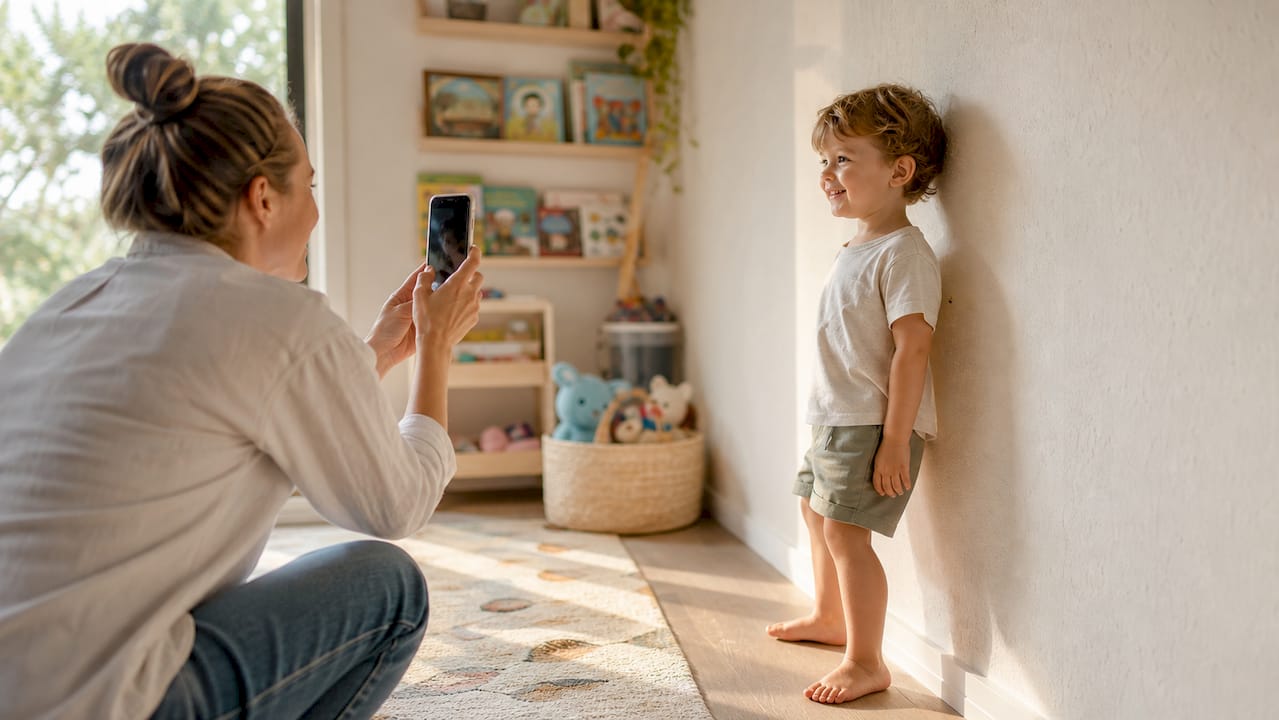
Take two photos. Front-facing and side-facing, full body, phone at roughly chest height.
Enter your height. This is the one manual input that anchors the scale of all other measurements.
Name the profile clearly. Something like “Mom, everyday” or “Liam, age 4” makes switching fast during a shopping session.
Add fit and style preferences if the platform supports them. Clothme lets you attach color, fabric, and style signals to a profile so the feed reflects more than just size.
Add family members as separate profiles. Each person gets their own photo set and preferences.
For children’s profiles specifically, check the platform’s consent and data handling policy before uploading photos of minors. Clothme’s photo guide walks through the photo process in detail.
Pro Tip: Re-take photos after significant weight changes, growth spurts, or when switching between seasons with very different layering. A profile that’s six months old for a fast-growing child may already be off by a full size.
For kids, update profiles at least every three to four months. For adults, once or twice a year is usually enough unless your body changes noticeably.
The faster shopping workflow you’ll actually use
Once profiles are saved, a typical session looks like this:
Open the feed filtered to a specific profile. Instead of browsing everything, you start with items already matched to one person.
Use fit badges to narrow to one or two items. SKU-level fit indicators tell you which specific size in which specific garment works for your profile. You’re not reading size charts.
Add the best-fit item to cart. Skip the spec-check unless you want a second opinion on something unusual.
Switch profiles to shop for another family member. One session, multiple people, no re-entering measurements.
Compare that to standard browsing: open a category, scroll, click a product, check the size chart, compare your measurements, read reviews for fit feedback, maybe add to cart, repeat. The profile-based workflow removes most of those steps. How color, fabric, and fit shape your feed explains how curated feeds work in practice.
Why parents save the most time with family profiles
Parents are the power users of size profiles, and the reason is straightforward: they’re shopping for multiple people with different sizes, different growth rates, and different style needs, often in a single session.
Growth-trajectory features let you select sizes that will fit a child for the next year or two rather than just right now. Industry reporting notes that kids’ sizing tools with growth forecasting help parents choose sizes that stay accurate for roughly 1–2 years, and a user survey found 95% of users rated such a tool as helpful.
Saved child profiles mean you’re not measuring your kids before every shopping session. You update the profile, and the feed updates with it.
Reduced return trips matter most for kids’ clothing, where sizing inconsistency across brands is worst. A profile that maps to actual measurements rather than age-based labels cuts the return rate on children’s items.
Gift shopping becomes faster too. A saved profile for a grandchild or niece means you can shop for them without calling to ask for measurements.
For more on navigating kids’ sizing, Clothme’s guide on shopping for kids as they grow covers the practical side in detail.
When profiles won’t save time, and how to protect family privacy
Size profiles are not universal. There are situations where they won’t give you enough confidence to skip a try-on:
Formal and tailored garments: A structured blazer or a wedding guest dress depends on drape and construction in ways that body measurements alone don’t capture.
Unfamiliar brands with no product dimension data: If a brand hasn’t provided garment measurements, the profile can only match to size labels, which are unreliable.
Stretch extremes: A fabric with 50% stretch behaves differently at different body proportions, and that nuance is hard to capture from photos.
Privacy matters, especially for children’s profiles. Before saving photos of minors on any platform:
Read the platform’s data retention and sharing policy.
Check whether photos are stored locally, on a server, or processed and discarded.
Understand how to delete a profile and its associated data if you choose to.
For children under 13, COPPA applies in the United States, so platforms should not collect personal data without verifiable parental consent.
Pro Tip: If a platform offers local-only processing or anonymized storage, use it. The fit accuracy is the same, and you’re not leaving photos of your family on a server indefinitely.
You can update or delete profiles at any time on Clothme. If a profile is outdated, removing it is better than letting it generate inaccurate recommendations.
What to look for when choosing a size-profile service
Not all size-profile tools are equal. Here’s a short checklist:
Accuracy evidence:
Does the platform publish measurement accuracy benchmarks? Look for average error under 3% and median error under 1 inch.
Is the methodology described? A volunteer test with tape-measure comparison is a meaningful signal.
Family features:
How many profiles can you save?
Does it support growth tracking for children?
Can you switch profiles quickly during a single shopping session?
Product-level fit mapping:
Does the service match your profile to garment construction data, or only to brand size labels?
Are fit indicators shown at the SKU level, not just the product level?
Usability and privacy:
Is the fit information easy to read at a glance? Research on adoption factors shows that perceived ease of use and self-efficacy are key drivers of whether shoppers actually use size tools.
What are the data retention policies for photos and measurements?
Are U.S. data handling standards clearly stated?
Understanding how personalized size data improves order accuracy can help you evaluate what a platform is actually offering versus what it’s marketing.
What research says about size profiles reducing friction
The evidence behind size profiles comes from three distinct areas:
Processing fluency: A 2022 study found that the ease and speed of processing fit information is a primary driver of e-shopping satisfaction with size recommendation services. Interfaces that surface fit signals clearly reduce cognitive load and speed decisions.
Claim Evidence type Practical implication Profiles reduce decision time Processing-fluency study (2022) Clear fit flags on product pages speed up evaluation Virtual fit data increases conversion Randomized field experiments Shoppers who see fit data buy more and return less Photo-based measurements are accurate Computer-vision test, 20 volunteers Average error under 3%, median under 1 inch for core measurements Growth tools help parents buy ahead Industry reporting, user survey 95% of users rated kids’ sizing tools as helpful; sizes stay accurate 1–2 years
The randomized field experiments are particularly useful here because they measure real shopping behavior, not just stated preferences. When shoppers have access to fit data, they convert at higher rates and generate fewer return-related costs. That’s a business signal, but it reflects a real shopper experience: confidence leads to commitment.
The computer-vision accuracy data matters because it sets a floor for what “accurate enough” looks like.
Understanding e-commerce conversion levers helps explain why retailers invest in fit technology: fewer abandoned carts, fewer returns, and higher repeat purchase rates all follow from shoppers who trust their size.
A note on Clothme’s approach
Clothme was built around the idea that shopping for a family shouldn’t require a measuring tape or a return label. The platform generates size profiles from two photos and a height entry, saves them for every family member, and filters product feeds so you see what fits rather than everything available. Accuracy and privacy are built into the process, not added as afterthoughts.
Clothme makes profile-based shopping practical for families
Clothme gives you saved, photo-generated size profiles for every family member in one place. Upload two photos, enter your height, and the platform builds a fit profile that filters your product feed automatically. You see items matched to your measurements, not a generic size grid.
Key features: save profiles for multiple family members, photo-based measurements with published accuracy benchmarks, curated feeds filtered by size plus style, color, and fabric preferences, and access to brands and boutiques you might not find through standard search. For parents, growth-trajectory support means you’re buying ahead, not catching up.
Create your profile on Clothme and run a session with your actual feed. The difference between browsing everything and browsing what fits is immediately obvious.
Sources
Journal of the Korean Society of Clothing and Textiles (processing fluency study)
Study of virtual fit information effects (randomized field experiments)
No need to drag your kids to the shops this Christmas! | Modern Retail