Maternity Size Guide for Pregnant Shoppers: Find Your Size
Start with your pre-pregnancy size. That’s the honest, unglamorous answer, and it holds for roughly 90% of maternity shoppers because most maternity lines size their garments to match your regular size, not your bump. If you wore a size 6 or a medium before you got pregnant, grab that same size in maternity first. Then confirm it against your body, not the label.
Three quick checks before you buy anything:
Measure your bust and hips right now and go with whichever number is larger. Maternity brands design around your widest point, not your pre-baby proportions.
Size up if you’re between two sizes, if you’re in your third trimester with more growth ahead, or if you’re carrying twins.
Check the product’s own size chart and the return policy before you check out. Every brand runs its numbers slightly differently, and a free return window saves you a trip to the post office.
If you nail those three things, you’ll get a workable size the majority of the time. Everything below fills in the details.
Key Takeaways
Your pre-pregnancy size is the right starting point for maternity clothes, and your dominant measurement, bust or hips, should confirm or adjust it from there.
Point Details Start with your regular size Your pre-pregnancy numeric or S/M/L size carries over directly in most maternity lines. Measure your dominant point Use bust for tops and nursing styles, hips for pants and skirts, to pick between close sizes. Size up when in doubt Go larger if you’re between sizes, entering the third trimester, or expecting twins. Re-measure each trimester Your belly and bust measurements shift fastest; check them again every few months. Confirm charts and returns Check the product’s own size chart and return window before ordering. Use ClothME for cross-brand fit A photo-based Clothme profile matches your measurements to sizes across multiple brands at once.
Table of Contents
What Is a Standard Maternity Size Chart?
Maternity sizing runs on the same S/M/L and numeric scale as regular women’s clothing. That’s the good news: you’re not learning a new system, you’re applying a familiar one to a changing body. The catch is that maternity brands measure your actual body, not the garment, because the fabric and cut are built to expand with you over several months.
Most U.S. maternity brands use a general reference chart mapping sizes to numeric equivalents and typical bust and hip measurement ranges, but exact numbers can vary by brand.
Manufacturers vary enough that a medium at one brand can run closer to a small or a large at another. Always check the product-level chart before you buy, and let your largest body measurement, not your habit or your closet history, make the call.
Which measurement matters depends on what you’re buying. For tops, dresses, and anything with structure through the chest, prioritize your bust measurement, especially if the piece is meant to double as a nursing top later. For jeans, leggings, skirts, and anything fitted below the waist, your hip measurement is the better guide, since that’s where maternity bottoms carry the most stretch panel design.
How Do You Measure for Maternity Clothes at Home?
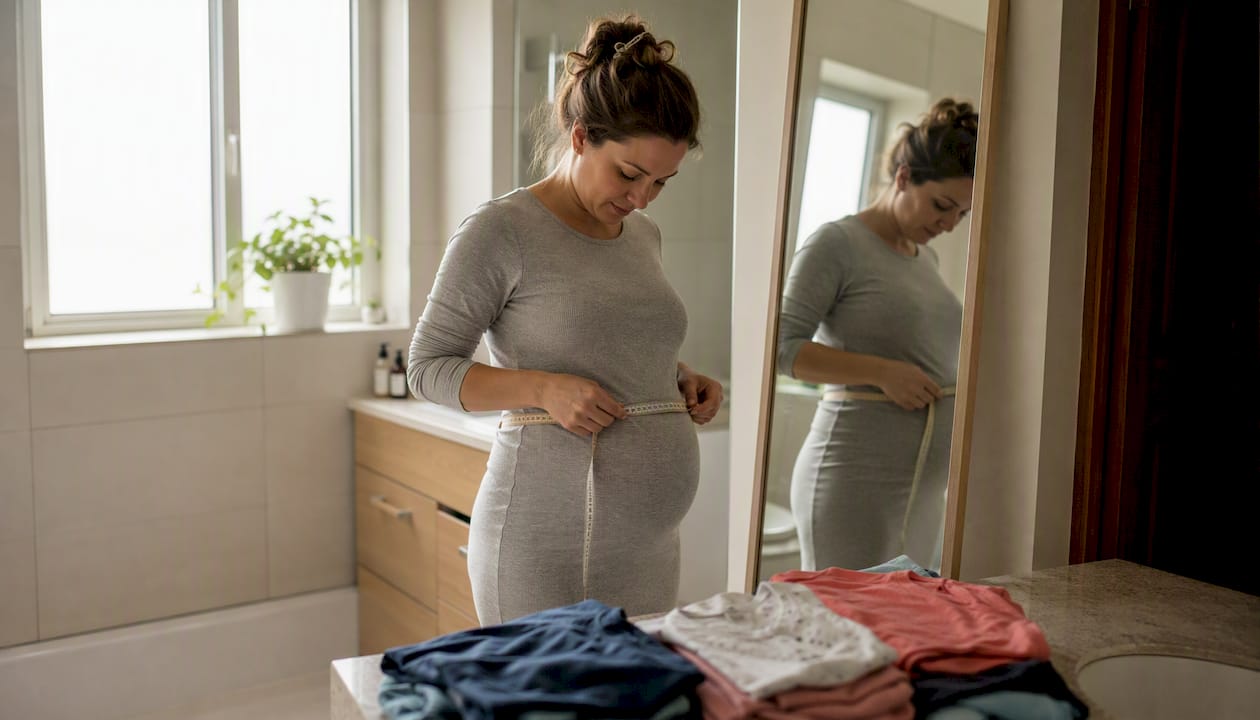
You need three things: a flexible tape measure, a mirror, and about five minutes in your underwear or close-fitting clothes. Skip the metal tape from your junk drawer. A cloth or vinyl sewing tape gives you an accurate read because it follows the curve of your body instead of fighting it.
Stand naturally with your feet together and your weight even. Don’t suck in or puff out. This is a measurement of you today, not an aspiration.
Measure your bust across the fullest part of your chest, keeping the tape level with the floor all the way around. It should sit snugly against your skin without compressing anything.
Measure your waist or belly at the point your brand’s chart specifies. Some brands measure at the natural waistline; others measure at belly-button height once you’re showing. Check which reference point the chart uses before you commit to a number.
Measure your hips around the widest part, usually a few inches below your belly button. This is the number that matters most for pants and skirts.
Measure your inseam using a pair of pants that already fits you well. Lay them flat and measure from the crotch seam to the hem.
As your bump grows, the waist and belly measurement is the one that shifts fastest. Re-measure at the start of each trimester rather than assuming your first-trimester numbers still apply in month seven. Your bust and hip measurements tend to stay closer to your starting point, though bra sizing is the one real exception. Breast size can change substantially during pregnancy, so get professionally fitted for bras or re-measure every few weeks instead of trusting your pre-pregnancy cup size.
Pro Tip: Measuring alone is easier than it sounds. Wrap the tape around yourself in front of a full-length mirror so you can see it stays level, or have a partner hold the end while you read the number. Write every measurement down in your phone’s notes app right after, labeled with the date, so you’re not guessing at your own numbers three weeks later. Our step-by-step measuring guide walks through each spot with more detail if you want a visual reference.
Does Your Regular Size Match Your Maternity Size?
Yes, in most cases, and this is the single most useful rule in maternity shopping. Your pre-pregnancy size is your baseline. Numeric sizes carry over directly, and S/M/L labels do too.
If you wore a size 6 before pregnancy, start with a maternity 6.
If you wore a medium, start with a maternity medium.
If you’re between two sizes normally, or you’re expecting twins, size up from your usual number.
Jeans and other bottoms labeled by waist number follow the same logic, and it’s one of the more useful things to know before you shop.
A pre-pregnancy waist size of 28 typically stays a 28 in the maternity version.
The stretch panel or belly band absorbs the growth, so the base number doesn’t need to change.
This means you can shop maternity denim by the exact number you already know, without converting anything.
Brand size charts back this up: they map your regular size straight across to their maternity line and flag exceptions, like the twins recommendation, as a separate note rather than a different sizing system. The one place this rule gets shaky is plus-size maternity lines, where brand variation is wider, so a product-level chart matters even more there.
How Do Top Maternity Brands Handle Sizing?
Brand charts share the same bones, your regular size as the starting point, but the fit notes differ in ways worth knowing before you order.
A few patterns show up across nearly every brand’s guidance:
Start with your pre-pregnancy size unless you’re between sizes, then size up.
Bust measurement drives fit for fitted tops, bodycon dresses, and nursing-friendly styles.
Hip measurement drives fit for jeans, fitted skirts, and structured pants.
Brands recommend sizing up for twins regardless of your single-pregnancy measurement.
Stretch-knit fabrics forgive more than woven fabrics, so a woven maternity dress often needs a truer-to-measurement size than a jersey one.
Fabric matters more in maternity than in regular clothing because your body is actively changing shape over months, not just days; for guidance on fit and fabric stretch, see the Best Swimsuits for Curvy Bodies style and fit guide. A four-way stretch knit can flex with you through most of a trimester. A woven cotton or denim with minimal give will feel tight faster, so buying that piece slightly roomier, or timing the purchase closer to when you’ll wear it, avoids an early re-buy.
What Should You Check Before Buying Maternity Clothes?
Run through this before you check out, whether you’re shopping online or standing in a fitting room.
Measure bust, waist/belly, and hips within the past two to three weeks, not from memory.
Pull up the product’s specific size chart rather than relying on the brand’s general chart.
Read the fit notes on the product page. “Runs small” or “true to size” changes your decision.
Look for customer photos showing their measurements next to the size they ordered.
Confirm the return window and whether return shipping is free before you commit.
On sizing up specifically: do it when you’re between two sizes, when you’re buying for the third trimester and expect more growth, or when the item is woven rather than stretch-knit. If you’re planning to layer, a cardigan over a fitted top or a jacket over a dress, size up on the outer layer specifically so it moves with you instead of pulling across your bump.
Check the return policy’s time window; many maternity brands give you 30 to 60 days, which matters since your body may not confirm the fit for a few weeks.
Try the item on as soon as it arrives rather than letting it sit, so you’re inside the return window if it doesn’t work.
If something doesn’t fit, note exactly where; too tight across the belly, too loose in the shoulders, so an exchange lands closer to right the second time.
Retailer size pages consistently recommend body measurements over garment measurements as the more reliable way to shop online.
How Does ClothME Take the Guesswork Out of Maternity Sizing?
Every brand chart above tells you roughly the same thing, start with your regular size, but “roughly” is the problem. A medium at one brand and a medium at another can differ by a full inch in the bust, and that gap only grows once you’re shopping across five or six brands trying to find something that actually fits your changing shape.
Clothme was built around that exact problem. Instead of asking you to interpret five different brand charts, it builds a size profile from two photos you upload, and matches that profile against real product measurements across partner brands and boutiques.
Here’s how a maternity shopper would use it:
Upload two photos to generate your personalized size profile.
Save that profile so you can update it each trimester as your measurements shift.
Browse curated product feeds that already match your saved sizing, style, and color preferences.
Check the recommended size against each product before ordering, since Clothme surfaces sizing per item, not a generic brand-wide guess.
Save a second profile for a partner or family member so you’re not repeating this process for every person you shop for.
Pro Tip: Re-upload your photos when you move into a new trimester rather than waiting until something stops fitting. Bump growth is the one variable that changes fastest, and a fresh profile catches that shift before you’ve already ordered the wrong size. For a closer look at how the photo-based sizing actually works, our guide to fit photos walks through what makes a usable shot.
A Practical Note on Shopping for Two Bodies at Once
Maternity shopping is a strange mix of practical math and emotional whiplash. You want to feel like yourself, and you also need clothes that will still fit in six weeks. I’ve found the calmest approach is boring on purpose: start with your regular size, measure again at the start of each trimester, and don’t treat a returned item as a failure. It’s just data.
The comfort-versus-style tension is real too. A woven wrap dress photographs beautifully and can feel tight by week 30. A stretch-knit tank isn’t going on anyone’s mood board, but it’s the piece you’ll actually wear on repeat. This guide leans toward giving you both: the measurements to get a confident fit, and enough brand-specific detail to still find pieces you like wearing.
Run through the measuring checklist above before your next order, and if you’re tired of guessing across five different brand charts, that’s exactly the gap a saved Clothme profile is built to close.
Get Personalized Maternity Sizing With ClothME
Clothme turns “which size do I actually need at this brand” into a two-photo answer instead of a guessing game. Upload two photos once, and Clothme builds a size profile that carries across partner brands and boutiques, so you’re not re-learning a new chart every time you shop for maternity wear.
Getting started takes a few minutes:
Create your profile and upload two photos from a flat, well-lit angle.
Save your current measurements so you can update them as your pregnancy progresses.
Browse the curated feed for sizes already matched to your profile, style, and color preferences.
Save a second profile for a partner or family member shopping for their own wardrobe.
Fewer wrong-size orders means fewer returns and less time spent cross-checking charts on five different brand websites. Start your size profile at Clothme and see your next maternity order matched before you check out.
Where to Verify Brand-Specific Measurements
Brand pages remain the final word on their own product measurements, since fabric, cut, and sizing philosophy shift between collections even within the same company.
BabyCenter’s maternity sizing guide for measurement technique and the pre-pregnancy sizing rule.
NOM Maternity’s size guide for baseline sizing and sizing-up guidance.
Isabella Oliver’s sizing guide for brand-mapped charts and twin pregnancy notes.
Bump Maternity’s sizing page for style-specific fit priorities.
Motherhood Closet’s size charts for jeans waist-labeling consistency and general retailer guidance.
Check the specific product page before you order, since even the brands above update their charts between seasons.
Frequently Asked Questions
Does my maternity size match my regular clothing size? Yes, for most brands. Your pre-pregnancy numeric or S/M/L size is the standard starting point, and you adjust from there based on your current bust and hip measurements.
What if I’m between two sizes? Size up. A slightly looser maternity garment stretches with you through the rest of your pregnancy, while a snug one may not last past the next few weeks.
Which measurement matters more, bust or hips? It depends on the garment. Fitted tops and nursing styles fit better when sized to your bust; pants, skirts, and jeans fit better when sized to your hips.
How often should I re-measure during pregnancy? At the start of each trimester at minimum. Your waist and belly measurement changes fastest, so re-measuring before a big purchase, like a wardrobe refresh for month seven, saves you a return.
Do maternity jeans use the same waist size as regular jeans? Generally yes. A 28 inch waist typically stays labeled 28 in the maternity version, since the belly panel is designed to absorb the growth rather than shift the base number.
Can ClothME help if I shop across multiple maternity brands? Yes. Instead of cross-referencing five separate brand charts, Clothme builds one photo-based profile and matches it to sizing across partner brands, which is especially useful once your measurements start shifting trimester to trimester.