Men’s Shirt Sizing: Measure, Decode, and Buy Right
Men’s shirt sizes are three things: a neck measurement in inches, a sleeve length in inches measured from the center-back of your neck, and a fit category. You can nail all three in five minutes with a soft tape measure. A label like “17 34/35” means a 17-inch neck and a 34–35-inch sleeve — that’s it. Once you have your numbers, buying the right shirt online stops being a gamble.
Three things to do right now:
Measure your neck at the base where your collar sits, leaving one finger of breathing room
Measure your sleeve from the center-back of your neck, over your shoulder point, to your wrist with your elbow slightly bent
Compare those numbers to the brand’s size chart — or save them in Clothme so you never have to re-measure
Key Takeaways
Accurate neck and sleeve measurements, combined with a reference shirt’s flat dimensions, give you everything you need to buy a shirt that fits across any brand or sizing system.
Point Details Measure neck and sleeve first Neck at the collar base with one finger of ease; sleeve from center-back of neck to wrist, elbow slightly bent. Decode numeric labels “17 34/35” means a 17-inch neck and a 34–35-inch sleeve — the two numbers that matter most for dress shirts. Prioritize garment measurements Compare a reference shirt’s flat dimensions to the brand’s garment chart rather than relying on S/M/L labels alone. Check the shoulder seam The seam must sit on the shoulder bone; if it falls off, no other fit adjustment will correct the silhouette. Use Clothme for cross-brand shopping Upload two photos to generate a saved size profile that matches your measurements to each brand’s garment dimensions automatically.
Table of Contents
What does “17 34/35” mean, and how do letter sizes map to inches?
The sizing mistake most men make — and the one habit that fixes it
How does men’s shirt sizing work when you measure yourself?
Accurate numbers are the whole game. Every fit problem — the collar that chokes, the sleeve that stops at your forearm — traces back to a measurement taken wrong or not at all. Here’s the exact method, step by step.
Neck. Wrap the tape around the base of your neck, where a collar would naturally sit. Slide one finger under the tape before you read the number. That finger-width of ease is what keeps a buttoned collar comfortable all day. Record to the nearest half inch.
Chest. Measure under your arms, across the fullest part of your chest, with the tape parallel to the floor. Keep your posture relaxed — don’t puff up or suck in. This number matters most for casual shirts and is a secondary check for dress shirts.
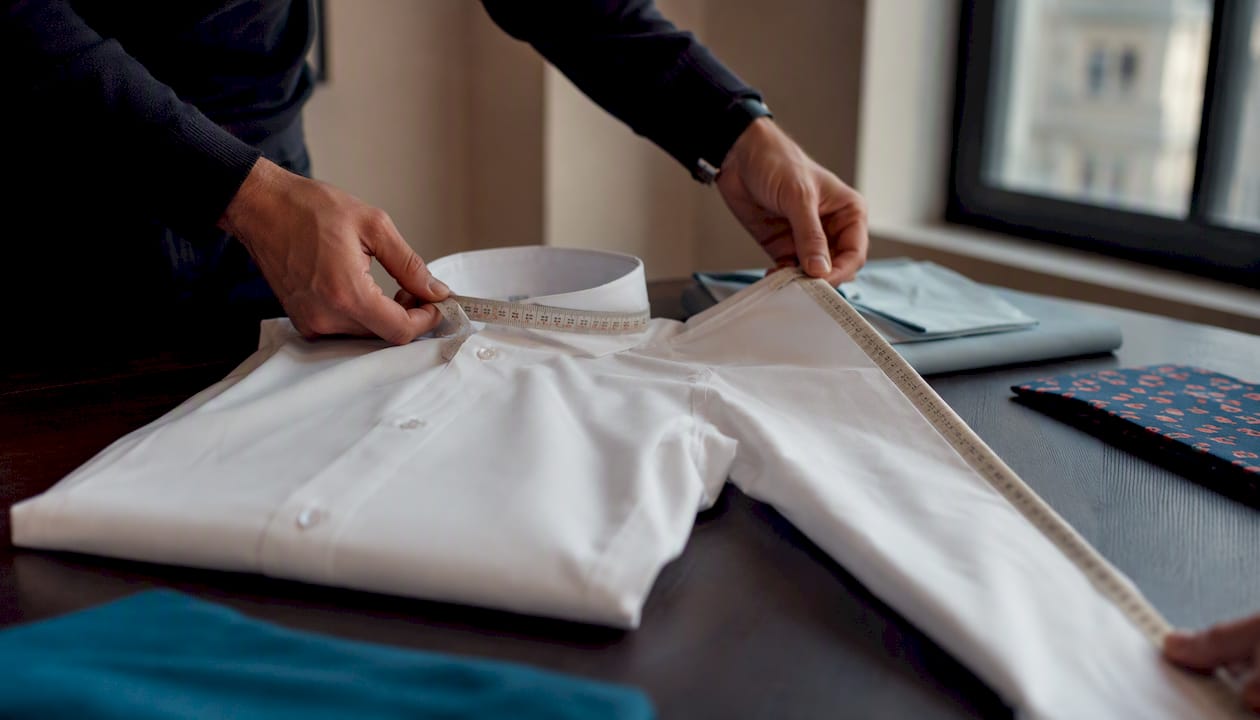
Sleeve. Start at the center-back of your neck, run the tape across your shoulder point, and continue down to your wrist. Bend your elbow slightly while measuring — that small bend accounts for natural arm movement, so the sleeve won’t pull when you reach forward. Primark’s men’s shirt size guide recommends this exact path and posture for consistent results.
Shoulder width. Have someone help you mark the point where your shoulder bone ends on each side. The distance between those two points is your shoulder width. This measurement is your best early warning for fit: if the shoulder seam on a shirt falls off the bone, nothing else about the fit will look right.
Shirt length. For a tucked shirt, measure from the top of your shoulder, down the front, to where you want the hem to end (typically mid-seat). For an untucked shirt, measure from the back of your neck to where you want the hem to fall.
Common mistakes to avoid:
Measuring over a thick sweater instead of a fitted tee or bare skin
Holding your breath or tensing your chest during the chest measurement
Measuring sleeve length from the shoulder tip rather than the center-back of the neck — this produces a number that’s consistently short
Rounding to the nearest whole inch when half-inch precision is what dress-shirt labels use
Pro Tip: Lay a shirt that already fits you perfectly flat on a table and measure it directly — chest across the back, collar circumference, sleeve from center seam to cuff. Those flat garment measurements become your personal reference template, and matching them to a brand’s garment chart is more reliable than any S/M/L label. Slater Menswear’s fit guide recommends this approach as a practical shortcut.
What does “17 34/35” mean, and how do letter sizes map to inches?
The number on a dress-shirt tag is a direct measurement, not a code. According to L.L.Bean’s men’s size chart, “17 34/35” means a 17-inch neck circumference and a sleeve length of 34–35 inches measured from the center-back of the neck to the wrist. Neck sizes typically run from 14 to 19 inches in half-inch increments. Sleeve lengths appear in paired values — 32/33, 34/35, 36/37 — because manufacturers cut one length and finish the cuff to fit either number.
A single number like “42” on a European-cut shirt usually refers to the chest measurement in centimeters, which converts to roughly a large in US sizing. In American retail, that same chest size would appear as an “L” on a casual shirt tag.
Numeric-to-letter chest size mapping (generic US ranges):
Letter Size Chest (inches) Neck (inches) Common Sleeve S 34–36 14–14.5 32/33 M 38–40 15–15.5 32/33 L 42–44 16–16.5 34/35 XL 46–48 17–17.5 34/35 XXL 50–52 18–18.5 36/37
The Tie Bar’s dress shirt size guide uses these same neck and sleeve ranges to translate chest measurements into S/M/L labels across their catalog.
Key points on dual-sleeve notation:
The paired value (e.g., 34/35) means the shirt is cut to fit both lengths — the cuff is adjusted during tailoring or by the wearer
If you measure 34.5 inches, order the 34/35 pairing; if you measure 35.5, go to 36/37
Dress shirts always list sleeve length; casual shirts usually don’t, which is one reason the two categories size differently
“Is a 42 medium or large?” In most US charts, a 42-inch chest maps to a large. But some slim-cut brands label 42 as an XL because their garments run narrower. Always check the brand’s specific chart — the letter is a shortcut, not a guarantee.
Which shirt fit is right for your body type?
Fit is geometry. Slim, tailored, and regular cuts differ in armhole depth, chest drape, and waist taper — not just overall width. Choosing the wrong fit means a shirt that looks sloppy or restricts movement even when the size label is technically correct. Paul Brown England’s fit guide explains that shoulder seam placement, armhole height, and waist taper are the construction details that determine how a shirt actually moves on your body.
Fit recommendations by body type and use-case:
Lean or slim build: Slim fit keeps the silhouette clean without excess fabric pooling at the sides. Works well for office and smart-casual settings.
Athletic build (broad shoulders, narrower waist): Tailored fit gives you chest room without the boxy drape of a regular cut. Slim fit often pulls across the shoulders on athletic builds.
Broader or fuller build: Regular fit provides ease through the chest and midsection. Look for brands that offer a “classic” or “relaxed” label — these have a higher armhole and more room through the body.
Taller than 5’11": Check for “tall” sizing options. Standard shirt lengths often leave the back untucked after a few hours of movement.
A properly fitted shirt lets you pinch a small amount of fabric at the side seam without any button strain. That’s the quick test. If you can’t pinch anything, the shirt is too tight; if you can grab a fistful, it’s too loose.
Pro Tip: For athletic builds, a deeper armhole in a tailored cut matters more than the chest measurement alone. A shirt with a high armhole restricts arm movement noticeably when you reach forward or raise your arms. Try the movement test — reach both arms forward and sit down — before committing to a fit type. The Clothme slim vs. regular fit guide breaks this down by build.
Why do brand size charts differ, and what should you check?
Brands use different construction blocks. A “medium” at one brand is built on a different body template than a “medium” at another — same letter, different geometry. There’s no single US standard that all brands follow, which is why cross-brand size variance is the norm rather than the exception.
Five things to check on any brand’s size chart before you buy:
Neck range: Does your measured neck fall in the middle of the listed range, or at the edge? Middle is safer.
Chest range: Check whether the chart lists garment measurements or body measurements — they’re different numbers.
Sleeve length: Confirm whether sleeve is measured from center-back or from shoulder tip. The two methods produce different numbers for the same arm.
Shoulder fit notes: Some brands list shoulder width separately; this is the most useful column if it exists.
Fit-type description: “Slim” at one brand may equal “tailored” at another. Read the description, not just the label.
Sample size chart rows (generic ranges for reference):
Measurement Medium range Large range Neck 15–15.5" 16–16.5" Chest 38–40" 42–44" Sleeve (center-back) 32–33" 34–35"
When in doubt, lay a shirt you already love flat and measure it — chest width across the back, collar circumference, sleeve from the center seam. Match those flat measurements to the brand’s garment measurements. That method beats S/M/L every time, as Primark’s size guide also recommends.
A note on shrinkage: Cotton shirts, especially those without pre-shrinking treatment, can lose half an inch to a full inch in length and width after the first wash. If you’re between sizes and the shirt is 100% cotton, size up. Blended fabrics (cotton-polyester) shrink less. Always check the care label before washing on hot.
How to choose the right size when shopping online
The process works best as a sequence. Skipping steps is where returns happen.
Measure yourself using the neck, chest, and sleeve method above. Write the numbers down.
Pull up the brand’s size chart and find the row where your neck and sleeve measurements land. For dress shirts, neck and sleeve are primary; for casual shirts, chest and shoulder are the main checks.
Compare your flat measurements from a reference shirt to the brand’s listed garment measurements when available. Garment measurements are the actual dimensions of the fabric — more reliable than body-measurement estimates.
Read the fit notes. “Trim,” “slim,” and “athletic” cuts run narrower through the chest and waist. “Classic” and “relaxed” give more room. If the product page uses these terms without defining them, check the brand’s fit guide page.
Check the return and alteration policy. A brand with free returns is lower risk when you’re unsure between two sizes. A tailor can fix sleeve length and waist taper for less than the cost of a return shipping label in most cities.
Quick shopping tips:
Prefer garment measurements over S/M/L labels whenever a brand lists them
Allow for fabric stretch on knit dress shirts — they can run a half-size small when new
“Trim fit” and “slim fit” are not interchangeable across brands; read the description each time
For team or specialty apparel, sizing conventions differ significantly — RNK Apparel’s hockey shirt sizing guide is a good example of how specialized garments require a different measuring emphasis than standard dress shirts
How Clothme solves the cross-brand sizing problem
Clothme converts two photos into a verified personal size profile, then uses that profile to match you to shirts across brands — so you’re not re-measuring or second-guessing every time you shop somewhere new.
How it works:
Upload two photos (front and side) through the Clothme platform
The system generates your measurements and builds a size profile
Save profiles for yourself and other family members
At checkout, Clothme matches your profile to each brand’s garment measurements automatically
Benefits you get directly:
Fewer returns from size mismatches
Consistent fit recommendations across brands that size differently
One profile covers the whole family — useful for parents shopping for kids whose sizes change frequently
Curated product feeds that show only items matching your style, color, and fabric preferences
Pro Tip: Take your two photos in fitted clothing against a plain wall with good lighting. The Clothme photo guide walks through exactly what the system needs to generate an accurate profile — getting this right the first time means your recommendations are accurate from day one.
How dress shirts and casual shirts size differently
Dress shirts and casual shirts use different sizing languages, and mixing them up is one of the most common reasons a shirt feels wrong even when the number seems right.
Dress shirts use the numeric system: neck circumference plus sleeve length, expressed as “16 34/35.” Every measurement is precise because dress shirts are worn with a collar buttoned and a tie or jacket — there’s no margin for a collar that gaps or a sleeve that disappears under a jacket cuff. Chest fit matters, but neck and sleeve are the primary numbers.
Casual shirts — polos, flannels, Oxford button-downs worn untucked — use S/M/L/XL almost exclusively. The chest measurement drives the size, and sleeve length is rarely listed because casual shirts are worn with a looser cuff and more movement tolerance. L.L.Bean’s men’s size chart maintains separate tables for dress and casual shirts, with dress shirts indexed by neck and sleeve and casual shirts indexed by chest and shoulder width.
The practical takeaway: if you’re buying a dress shirt, lead with your neck and sleeve numbers. If you’re buying a casual shirt, lead with your chest measurement and check the shoulder width if the brand lists it.
Understanding plus sizes and extended sizing options
Extended sizing — often labeled Big & Tall, plus, or XB/XL Tall — follows the same measurement logic but applies it to a wider range of body proportions. “Big” sizing adds width through the chest, shoulders, and body without necessarily adding length. “Tall” sizing adds length to the body and sleeves without widening the chest. “Big & Tall” combines both.
For dress shirts in extended sizes, the neck and sleeve notation still applies. A “17.5 36/37 Big” shirt has a 17.5-inch neck, a 36–37-inch sleeve, and extra room through the chest and body. The key difference is that the chest-to-neck ratio is adjusted — a standard large might have a 44-inch chest and a 16.5-inch neck, while a 1X or XB at the same neck size offers significantly more chest room.
When shopping extended sizes online, check whether the brand lists garment measurements separately for their plus or tall cuts. Many brands use the same S/M/L label across standard and extended lines but build them on different blocks — the garment measurements column is the only way to know what you’re actually getting. If a brand only lists body measurements, use the flat-measurement method from a well-fitting shirt in your current size as your comparison point.
The sizing mistake most men make — and the one habit that fixes it
The most common errors aren’t about vanity or guessing wrong. They’re procedural. Measuring inconsistently — different posture, different tape tension, different starting point for the sleeve — produces numbers that don’t match any chart reliably. Trusting letter sizes alone is the second mistake: a medium from one brand fits like a large from another, and there’s no universal standard forcing them to agree. The third, and the one that costs the most in returns, is ignoring shoulder seam placement. A shirt can fit perfectly through the chest and still look wrong if the seam sits half an inch off the shoulder bone.
The single habit that fixes most of this: measure once correctly, record a reference shirt’s flat measurements, and use those two data points together every time you shop. Your body measurements tell you where you fall on a chart. Your reference shirt’s flat measurements tell you what a good fit actually looks like in fabric. Together, they give you a check that works across brands, fit types, and sizing systems.
The shoulder seam is the detail worth obsessing over. According to Paul Brown England’s shirt fit guide, the seam must sit on the shoulder bone for the shirt’s silhouette to read correctly — everything from the sleeve hang to the chest drape depends on that one point being right.
Your size profile, ready for every brand
Measuring once and re-entering your numbers on every brand’s site is the friction that makes online shirt shopping frustrating. Clothme removes that step entirely. Upload two photos, get a verified size profile, and shop with confidence knowing your measurements are matched to each brand’s actual garment dimensions — not just their S/M/L labels.
Two quick benefits worth noting: your profile reduces returns by matching you to shirts that fit before you buy, and you can save separate profiles for every family member, so shopping for a partner or a kid doesn’t mean starting from scratch. To get started, visit Clothme, upload your two photos, and let the platform build your profile. It takes a few minutes and pays off every time you shop for a shirt.
Sources
Men’s Measurement Chart | Men’s Size Guide | L.L.Bean for Business | L.L.Bean for Business
How to Choose the Right Shirt Fit for Your Body Type | Paul Brown England