How to Surprise Your Partner with the Right Clothing Size
The single most reliable approach: check the tag on a garment they already wear well, then buy the same size in a forgiving style. That one move eliminates most of the guesswork. If you can’t get to their closet, a photo-based sizing service like Clothme gives you a precise fit profile without a single awkward question.
Clothing sizes vary wildly across brands. A size Medium at one retailer can fit like a Large at another. Add the emotional weight of a surprise gift and the stakes get real fast. The methods below give you a clear path from zero information to a confident purchase.
Table of Contents
2. How to take flat measurements from a garment in their closet
3. How to convert measurements to U.S. sizes and handle brand variance
4. Safest clothing items to buy as a surprise and what to skip
5. How to plan for returns so the surprise stays a good memory
7. How Clothme solves the sizing problem when you can’t measure
1. How to find your partner’s size without asking directly
Five methods, ranked by accuracy. Pick the one that fits your situation.
Method 1: Closet tag-check (accuracy: high)
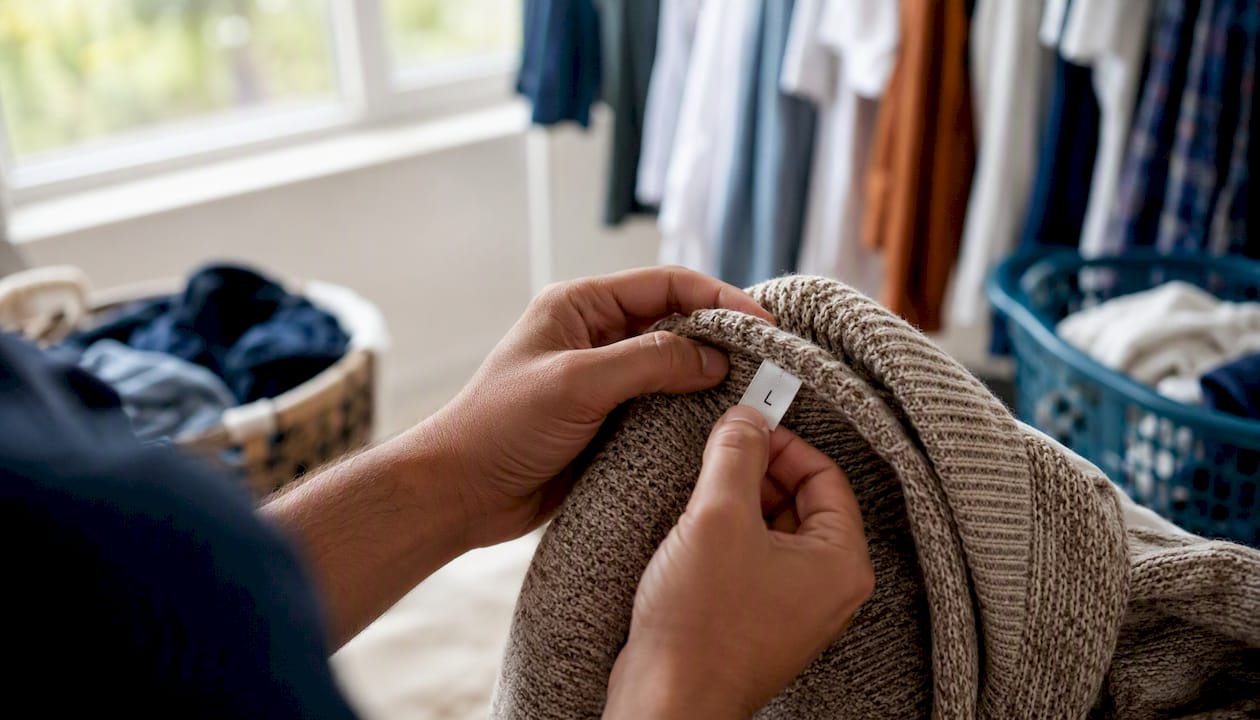
This is the gold standard. Slip into their closet and pull out two or three garments they wear regularly and that clearly fit well. Check the brand, size label, and garment type on each. A well-worn, well-fitting shirt tells you far more than a dress still in the bag. According to SWAGGER Magazine, it’s common to find a range of sizes across one person’s wardrobe. When that happens, note the range and lean toward the upper end.
Pros: Precise, free, no social risk. Cons: Requires closet access.
Method 2: Order history or online accounts (accuracy: medium-high)
If you share a household and they shop online, a recent order confirmation email or a saved address in a retailer’s app often shows the size purchased. Check carefully: people sometimes order multiple sizes to try on, so look for repeat purchases of the same size across different items.
Pros: No physical access needed. Cons: Privacy boundary to consider; not always conclusive.
Method 3: Enlist a friend or family member (accuracy: medium)
A trusted friend who shops with your partner regularly is a surprisingly reliable source. Keep the ask simple: “I’m buying them a gift and want to get the size right. Do you happen to know?” Most people are happy to help without spoiling anything. Navas Lab’s community-tested tactics confirm that asking a mutual friend is one of the cleaner stealth methods.
Pros: Socially low-risk. Cons: Depends on the friend’s knowledge and discretion.
Method 4: Use a full-body photo (accuracy: low-medium)
A clear, recent full-body photo can help you estimate general build, but it won’t give you a reliable size on its own. Where it does work: bring the photo to a store and ask a sales associate. The Guardian notes that many retail staff can estimate sizing from a photo or by matching a well-fitting garment you bring in.
Pros: Useful when combined with in-store help. Cons: Imprecise on its own.
Method 5: Conversational sleuthing (accuracy: low)
Casual questions like “I saw this brand runs small, do you usually size up?” or “What size do you usually grab in jeans?” can surface the information naturally. Keep it light and context-specific so it doesn’t feel like an interrogation.
Pros: No access required. Cons: Easy to tip off the surprise; unreliable if they deflect.
2. How to take flat measurements from a garment in their closet
If you can access one well-fitting garment, flat measuring it gives you numbers you can plug directly into any online size chart. This technique is reliable for shirts, jackets, and dresses; pants are harder because of inseam and rise variations.
Step-by-step instructions:
Lay the garment flat on a hard surface, smoothed out but not stretched.
Chest/bust: Measure straight across the front from armhole seam to armhole seam, then double it.
Waist: Measure across the narrowest point of the garment, then double it.
Hips (dresses, skirts, pants): Measure across the widest point below the waist, then double it.
Shoulder width: Measure from shoulder seam to shoulder seam across the back.
Sleeve length: Measure from the shoulder seam to the cuff edge along the outside of the sleeve.
Inseam (pants only): Measure from the crotch seam straight down to the hem. Note: this measurement alone won’t tell you rise or cut, which is why pants remain the hardest item to buy as a surprise.
Write down the brand name alongside every measurement. Sizing varies enough between brands that a 38-inch chest measurement maps to different sizes at different retailers.
Measurement Where to measure on the garment Common size chart input Chest/bust Across front at armhole, doubled Bust (inches) Waist Narrowest point, doubled Waist (inches) Hips Widest point below waist, doubled Hip (inches) Shoulder width Seam to seam across back Shoulder (inches) Sleeve length Shoulder seam to cuff Sleeve (inches) Inseam Crotch seam to hem Inseam (inches)
Note the fabric content too. A 100% cotton shirt will have less give than a cotton-spandex blend, so the same measurement may need a size up in a stiffer fabric.
3. How to convert measurements to U.S. sizes and handle brand variance
Measurements in hand, the next step is matching them to a size. Every major U.S. retailer publishes a size chart, and you should always use the chart for the specific brand you’re buying from. General conversion tables are a starting point, not a guarantee.
A quick conversion checklist:
Confirm you’re reading the right chart: women’s and men’s sizing are entirely separate systems.
Check whether the chart uses body measurements or garment measurements. Most U.S. brand charts use body measurements, so if you measured a garment flat, add roughly 1–2 inches to account for ease.
Note the brand’s region. Some brands use European sizing on their labels even when sold in the U.S. A clothing size conversion chart can help you translate between systems quickly.
Brand variance is real and well-documented. Vanity sizing, different fit models, and cut variations mean a size 8 at one brand can be a size 10 at another. This inconsistency across brands is one of the most common reasons clothing gifts get returned.
Pro Tip: When you’re caught between two sizes, always go larger for structured garments like blazers and button-downs. For stretchy or knit fabrics, the smaller size usually still works. A gift that’s slightly loose reads as generous; one that’s too tight creates an awkward moment.
4. Safest clothing items to buy as a surprise and what to skip
Some garments are forgiving by design. Others require a near-perfect fit to look right. Here’s how to think about the risk before you buy.
High-safety picks (buy with confidence):
Dressing gowns and robes: Knitwear and dressing gowns accommodate a wide range of body types, making them reliably low-risk.
Activewear with stretch: Leggings and athletic tops in spandex blends tolerate size variation well. For sport-specific gear, a hockey apparel size guide shows how specialty sizing charts can help narrow the range for performance fits.
Medium-risk (size up when unsure):
High-risk (avoid unless you have precise measurements):
Tailored pants and trousers: Experts consistently advise against buying trousers as a surprise gift. Waist, inseam, rise, and cut all have to align simultaneously.
One style tip that cuts across all categories: neutral colors and familiar silhouettes are safer than bold prints or trend-driven cuts. A gift that fits their existing wardrobe gets worn. One that doesn’t gets returned.
5. How to plan for returns so the surprise stays a good memory
A gift receipt is not an afterthought. It’s the single most important thing you can do after choosing the right size. Keeping the receipt and planning for returns is standard advice from every clothing gift expert, and for good reason: even a well-researched size can miss.
Before you buy, check:
Return window length (30 days minimum; 60 is better for holiday gifts)
Whether the item is final sale or excluded from returns
Whether online purchases can be returned in-store
Tag and packaging requirements for returns (most require original tags attached)
When you wrap the gift:
Leave tags on and tuck them discreetly inside the packaging.
Include the gift receipt inside the box, not just in the bag.
Keep your own proof of purchase separately.
A short note inside the gift removes any pressure without diminishing the gesture:
That one sentence does a lot of work. It signals that you thought about fit, that you’re not attached to the size being perfect, and that returning it won’t hurt your feelings.
7. How Clothme solves the sizing problem when you can’t measure
When closet access isn’t possible and the conversational approach feels too risky, Clothme offers a practical fallback. The platform generates a personalized size profile from two uploaded photos, then filters product recommendations to match that profile across brands.
What Clothme does that manual methods can’t:
Photo-based sizing profiles account for body shape, not just measurements, which is why two people with the same bust measurement can wear completely different sizes in a fitted top.
Saved profiles for multiple family members mean you can set up your partner’s profile once and reference it for every future gift.
The platform’s height and weight calculator gives you a starting size estimate when you have general body data but no garment to measure.
Brand-aware recommendations reduce the variance problem: instead of applying one size chart to every brand, Clothme adjusts for how individual brands fit.
How to use it discreetly for a surprise:
Ask your partner to take two photos for a different reason (a shared app, a style quiz, or simply “I want to show you something”) or use existing photos with their knowledge.
Upload the photos to create their size profile.
Save the profile under their name in your account.
Browse Clothme’s curated product feed, filtered to their size and style preferences.
Purchase directly through the platform, where sizing is already matched.
Compared to manual methods, Clothme trades a little setup time for significantly higher accuracy, especially across multiple brands. The right fit guide on the Clothme blog walks through how profiles map to specific garment types, which is useful when you’re deciding between a wrap dress and a fitted style.
Key Takeaways
Getting a clothing gift size right comes down to one principle: use real evidence (a tag, a measurement, a profile) rather than a guess.
Point Details Start with a tag check Pull two or three well-fitting garments from their closet and note the brand and size on each. Measure flat when possible Lay a garment flat and measure chest, waist, and hips; double the measurement for body size. Size up when between sizes For structured garments, the larger size is almost always the safer call. Always include a gift receipt Check the return window before buying and leave tags on inside the packaging. Use Clothme when access is limited Photo-based profiles on Clothme give accurate, brand-aware size recommendations without a tape measure.
The part most gift guides skip
Clothing gifts carry more emotional weight than most people account for. The size on a tag is just a number, but getting it wrong can make someone feel seen in the wrong way. That’s the real risk, and it’s why the “just size up” advice, while technically sound, only solves half the problem.
The other half is choosing items that don’t put the recipient in an awkward position. A beautifully wrapped sweater in a forgiving knit says “I thought about you.” A pair of tailored trousers that don’t fit says “I guessed, and I guessed wrong.” The garment type matters as much as the size.
What I’d push back on in most gift guides is the framing that a gift receipt makes everything fine. It helps, but it doesn’t remove the moment of opening something that doesn’t fit. The better move is to reduce that risk upfront: choose flexible silhouettes, use real sizing data, and reserve the surprise element for the style choice, not the fit.
For partners going through any kind of body transition, the most emotionally intelligent gift is one that doesn’t require a size at all. That’s not a cop-out. It’s good judgment.
Useful sources and further reading
Buying Clothes for Your Wife or Girlfriend? Here’s What You Need to Know - SWAGGER Magazine
Gifts Of Clothes: How To Avoid Size-Related Shopping Dilemmas
How to buy clothes as a gift: keep the receipt and never buy trousers - The Guardian
How to Find Clothes That Fit Every Time: A 2026 Guide | ClothME Blog
Calculate Dress Size Based on Height and Weight | ClothME Blog