Stop Fit Guesswork: Use Two Photos to Outsmart Vanity Sizing
Vanity sizing is the practice of labeling a garment with a smaller number than its actual measurements would justify under older sizing standards, a form of size inflation that has crept through American retail for decades. The tag’s number tells you almost nothing reliable; your own measurements, checked against each brand’s specific size chart, tell you almost everything. What follows is the evidence behind that claim, the psychology that keeps the practice profitable, and a shopping method that works regardless of what any label says.
TL;DR:Size inflation is driven by brands gradually loosening patterns while keeping label numbers small, causing significant measurement discrepancies between retailers.
Shopping based on personal measurements and brand-specific size charts reduces confusion and minimizes returns caused by inconsistent sizing.
Photo-based sizing tools can automate measurement calibration, saving time and offering consistent profiles for different family members or repeat purchases.
Vanity sizing creates emotional distortions, making shoppers see smaller sizes as a reflection of real body changes or improvements, which is often misleading.
Industry incentives favor size inflation because it increases sales by psychologically appealing to shoppers, despite undermining fit predictability and trust.
Clothme
Find Sizes That Fit Your Family
ClothME uses two photos to create personalized size profiles, helping you shop across brands with less guesswork for every family member.
Find your personalized size
Table of Contents
What Vanity Sizing Is and Where It Came From
Vanity sizing didn’t happen overnight. It’s the slow result of a regulatory vacuum. The United States once had a real reference point for clothing sizes: the Commercial Standard CS 215-58, a voluntary sizing standard developed in the 1940s and formalized in 1958 based on measurements of thousands of women. It was never mandatory, and manufacturers who found it commercially inconvenient simply ignored it, but it gave the industry a shared baseline.
That baseline disappeared in 1983, when the federal sizing standard was officially withdrawn. No replacement stepped in. Brands were left free to define “size 8” or “medium” however they wanted, and market pressure pushed most of them in one direction: smaller numbers, bigger garments.
Here’s how that played out over time:
1958: CS 215-58 establishes a common sizing reference based on body-measurement surveys.
1983: The standard is withdrawn, and no federal replacement follows.
1980s to 2000s: Retailers gradually widen pattern blocks while keeping size labels flat or shrinking them, a process reinforced by fit-model changes and competitive pressure to make shoppers feel good at checkout.
2010s to present: Size charts diverge so far between brands that a labeled size 6 in one store can match a labeled size 12 in another.
None of this required a conspiracy. Small, iterative pattern adjustments compound. A brand that quietly loosens its size 10 pattern by half an inch this year and again in three years eventually ends up with a garment that would have been labeled a 14 under the old standard.
What the Research Actually Shows
The clearest empirical picture comes from a 2017 analysis of 54 American apparel retailers, which measured more than a thousand data points across chest, waist, hip, and neck sizing. The pattern was not subtle.
That split makes sense once you think about who buys what. Mid-price women’s brands compete on volume and repeat purchases, so a flattering label number is a real conversion tool. Designer brands sell exclusivity and precision fit, so they have less incentive to inflate.
The same study found something else worth noting: little to no evidence of size inflation in men’s or children’s clothing. A few reasons converge here:
Men’s clothing frequently uses actual body measurements on the label (a 34x32 pant, a 16.5 neck shirt), which leaves less room for a flattering fudge.
Children’s sizing is tied closely to age and growth charts, which parents cross-check constantly.
Women’s apparel, especially in letter sizes like S/M/L, has the least standardized reference point of any category, which is exactly where drift accumulates fastest.
Trade reporting on measurement spreads backs this up with real-world examples: the same labeled size, measured with a tape at retailers a few blocks apart, can differ by two inches or more at the waist.
Who Gets Hurt When Sizing Drifts
Inconsistent sizing does more than create mild annoyance at checkout. It raises the odds you’ll order the wrong size, and it raises them differently depending on who you are and what you’re buying.
The most immediate cost is returns. When a size 8 fits three different ways across three different brands, shoppers order multiple sizes just to hedge, then send back what doesn’t work. Retailers absorb that cost, but shoppers absorb the time and the friction of repackaging, printing labels, and waiting on refunds.
Smaller-bodied shoppers face a distinct problem. As nominal sizes drift upward across the industry, the smallest labeled sizes shift with them, or brands simply stop stocking the true smallest sizes because volume in that range doesn’t justify production runs. What used to be a standard small can become genuinely hard to find in stores that have moved their whole size curve upward.
A few patterns show up consistently:
Price tier matters more than category: budget and mid-market women’s brands drift the most.
Fast-fashion retailers, competing hardest on perceived value, show some of the widest measurement spreads.
Petite and extended-size shoppers face the sharpest mismatch between labeled and available sizing.
Why Vanity Sizing Works on Shoppers
The psychology here isn’t complicated once you see the mechanism. Research in the Journal of Consumer Psychology found that a smaller size label produces more positive self-related mental imagery. In plain terms, seeing a smaller number on the tag makes shoppers picture themselves looking better in the garment, before they’ve even tried it on. That imagined outcome raises purchase intentions.
The effect isn’t uniform. It’s stronger among shoppers with lower appearance self-esteem, meaning the people most vulnerable to a flattering number are the ones most swayed by it.
A garment’s actual fit hasn’t changed at all. What changes is the story a shopper tells herself the moment she reads the tag, and that story alone can tip a sale.
That same mechanism cuts the other way. When a shopper eventually discovers the inflated sizing, some of that goodwill curdles into something closer to distrust. Feeling misled by a label erodes confidence in a brand and can push buyers toward compensatory purchases elsewhere to offset the disappointment.
Pro Tip: If a brand’s label consistently runs small or large for you, that’s not a personal failing, it’s a documented industry pattern. Write it down once, and you never have to relearn it.
How to Shop Smart When the Label Lies
The fix isn’t complicated, but it does require breaking the habit of trusting a number you didn’t choose. Measurement-first shopping treats the size on the tag as a suggestion, not a fact.
Measure three points on your body: bust or chest, waist, and hips. Use a soft tape measure, keep it parallel to the floor, and measure over light clothing rather than bulky layers.
Write those numbers down and save them. This one step eliminates most sizing guesswork before you even open a retailer’s site.
Check the brand’s own size chart every single time, and ignore the label number entirely until you’ve confirmed it against your measurements. A brand’s medium and another brand’s medium are not the same garment.
Place one calibration order per new brand. Buy a single item, try it on, and note whether it ran true to your measurements, small, or large.
Build a personal offset table. After a few calibration orders, you’ll have a running list: “Brand A runs one size small, Brand B runs true, Brand C’s mediums fit like larges.” That table becomes more valuable than any generic size chart.
Adjust for fabric and cut, not just size. A size that fits perfectly in a woven cotton shirt might need to go up a size in a stiff denim with no stretch, or down a size in a heavily stretchy knit.
Read fit notes in reviews before ordering. Comments like “runs small in the shoulders” or “true to size but long in the torso” often carry more useful information than the chart itself.
Pro Tip: Keep your measurement and offset notes in one place, whether that’s a notes app or a spreadsheet. The five minutes it takes to log a new brand saves you a return shipment every time.
Handled this way, returns drop and the process of picking a size stops feeling like trial and error. For more detail on measuring technique, how to measure accurately walks through the specific landmarks that matter most for each measurement.
How Photo-Based Sizing Tools Cut Through the Guesswork
A measurement-and-calibration system works, but it takes real effort to maintain by hand, especially if you’re shopping for more than one person. This is where a tool built specifically around the problem earns its place.
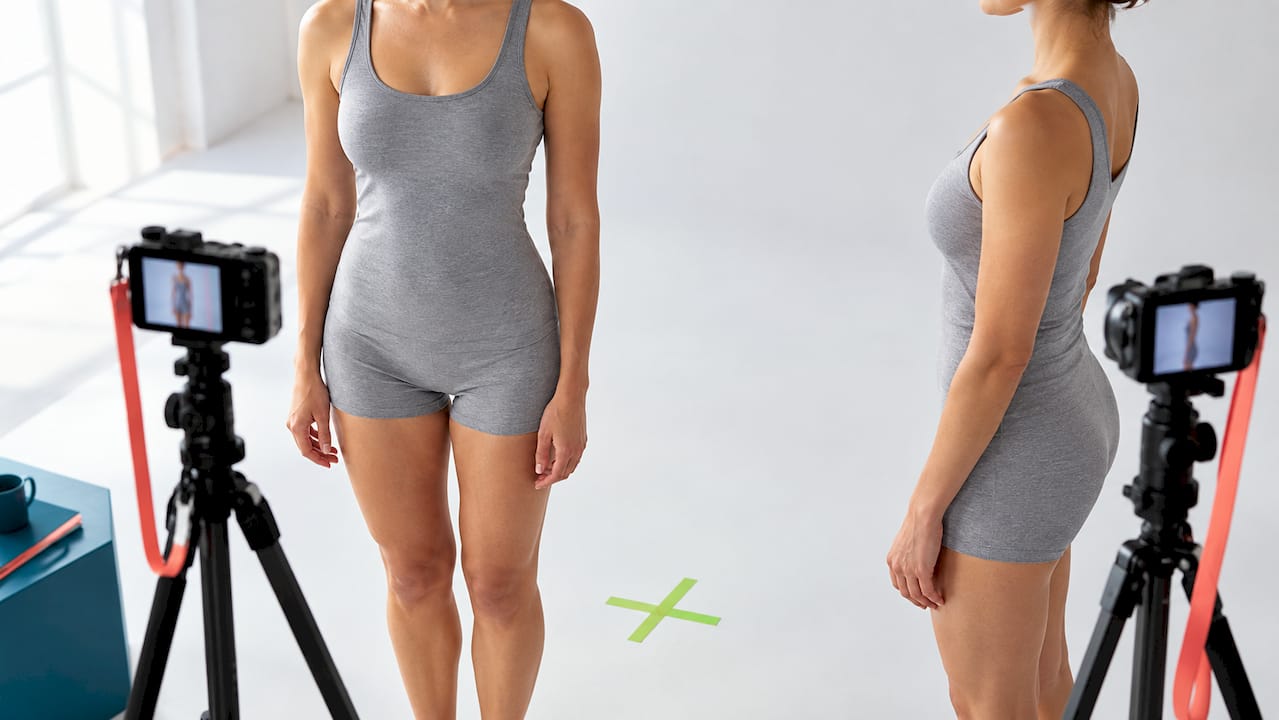
A photo-based sizing tool lets you upload two photos and generates a size profile without requiring you to pull out a tape measure yourself. That profile then filters product recommendations to items likely to match your actual body, rather than showing you every item in a brand’s catalog and leaving you to guess.
For a household, the bigger advantage shows up over time:
Each family member can have a saved profile, so a shopper isn’t rebuilding the calibration process from scratch every time.
Product feeds can be filtered by style, color, and fabric preference in addition to fit, so recommendations stay relevant, not just size-accurate.
Consistent profiles across orders mean you’re not re-guessing a brand’s sizing quirks every visit.
A parent who has already gone through the trial-and-error of ordering the wrong size twice for a growing child knows exactly how much time a saved, accurate profile can save on the third order.
Vanity Sizing and How We See Our Own Bodies
Size labels carry more emotional weight than a piece of fabric probably should. When a shopper reaches for a smaller size than they wore five years ago, purely because brands widened their patterns, it can create a false sense of physical change that has nothing to do with an actual body.
That disconnect runs both directions. Some shoppers feel a genuine boost when a familiar size number appears in a new brand’s small offering, even though nothing about their body prompted it. Others feel real distress when a brand runs its sizing the opposite way, labeling a true medium as a large and delivering a moment of unearned discouragement at the fitting room mirror.
Neither reaction is really about the body in front of the mirror. Both are about a number that was set by a pattern maker, a fit model, and a marketing team, not by any external standard tied to measurements. The wider cultural effect is a kind of sizing illiteracy: shoppers grow up cross-referencing their self-worth against tag numbers that were never standardized in the first place, and that comparison gets harder to escape the more brands compete on flattering labels rather than transparent measurements.
The healthiest reset available to any shopper is treating the tag as arbitrary from the start. A size 10 is not a fact about your body. It’s a decision one company’s design team made about where to draw a line on a chart, and that line moves depending on who drew it.
How Vanity Sizing Differs Around the World
Size inflation isn’t a uniquely American habit, but it doesn’t look the same everywhere. The United States lost its federal reference point in 1983 and never replaced it, which left the widest possible room for individual brands to drift. The United Kingdom has documented similar inflation over time, with letter and number sizes both loosening compared to older reference measurements.
Countries that maintain centralized or more actively enforced sizing standards tend to show less drift, simply because there’s a shared reference brands are expected to work from rather than one they’re free to ignore. That doesn’t mean sizing is perfectly consistent anywhere. It means the room for individual brands to inflate labels shrinks when a real external standard still exists and gets used.
The practical result for anyone shopping internationally, or from brands based outside the United States, is that a size conversion chart is only a starting point, never a guarantee. A European 38, a UK 10, and a US 8 might roughly line up in theory, but two brands within the same country can already disagree on what their own size 8 means. Layering a cross-border conversion on top of that just adds another source of drift. Checking a size conversion reference is a reasonable starting point, but it still needs to be confirmed against the specific brand’s own chart and, ideally, your own saved measurements.
Why Retailers Keep Doing This
Vanity sizing persists because it works financially, at least in the short run. A smaller label number creates a small psychological win at the exact moment a shopper is deciding whether to buy, and that win translates into measurable conversion gains.
The economics behind the practice involve a straightforward tradeoff. Brands weigh the sales lift from a flattering size label against the cost of increased returns when the garment doesn’t actually fit as expected, and for a lot of retailers in the moderate price range, that lift outweighs the return cost. It’s a volume game: even if some shoppers eventually return an item or feel misled, enough of them keep the garment or don’t bother with a return that the practice remains profitable overall.
There’s also a competitive dimension. Once a handful of major retailers start inflating sizes, staying with the older, tighter standard becomes a competitive disadvantage. A shopper trying on a true-to-standard size 12 at one store and a vanity-sized 8 at another is likely to feel better at the second store, regardless of which one actually fits better. That dynamic pulls the whole mid-market in the same direction over time, which is part of why the drift shows up so consistently across dozens of brands rather than in a few isolated outliers.
Designer brands mostly opt out of this race because their customers aren’t shopping on the same psychological trigger. Precision fit and craftsmanship are the pitch, not a flattering number.
What Vanity Sizing Does to Fit Consistency and Expectations
The most direct casualty of size inflation is predictability. Shoppers used to be able to buy a size 10 from three different stores with reasonable confidence they’d get three similarly fitting garments. That confidence has largely evaporated in the mid-market women’s category, where size charts diverge widely enough that the label has become close to meaningless without a chart check.
This shift changes shopping behavior in ways retailers don’t always account for. Shoppers order multiple sizes as insurance, which drives up both shipping costs and return volume industry-wide. Others simply stick to two or three brands they’ve already calibrated, avoiding new retailers entirely because starting the guessing process over feels like too much friction. That’s a real loss for brands trying to win new customers, even if vanity sizing helped them close a first sale.
The expectations gap also shows up in customer service and reviews. A huge share of online apparel reviews now mention fit specifically, phrases like “runs small,” “true to size,” or “order a size up,” because shoppers have learned they can’t trust the chart alone. That’s a workaround born entirely out of necessity, and it’s a sign the labeling system itself has stopped doing its job. A consistent, calibrated approach on the shopper’s side, tracking real measurements against each brand’s actual chart, is the only reliable substitute for a standard the industry walked away from more than forty years ago.
Industry Economics vs. Shopper Wellbeing
Retailers aren’t wrong to chase the conversion lift vanity sizing provides. That’s a rational business response to a standard that no longer exists. The real problem is the absence of transparency, not the psychology itself.
The fix on the shopper side is measurement-first, not label-first, paired with tools that make calibration painless instead of tedious. Try it once this week: measure yourself, order one calibration item from a brand you’ve never bought, and see how close the chart actually gets you.
— admin
Try Clothme’s Free Size Tool Before Your Next Order
Clothme’s Free Size Tool turns the measurement-first method into something you can do in minutes instead of managing by hand. Upload two photos, and it builds a size profile without asking you to measure yourself with a tape and cross-reference a chart every time you shop.
That profile becomes especially useful once you’ve read this far, because it applies the same calibration logic the research supports, just automated. You can save a profile for each family member, so sizing a growing child or a partner doesn’t mean starting from zero every season. Product recommendations then filter to items that actually match those saved measurements, along with style, color, and fabric preferences, which cuts down the back-and-forth of returns tied to guessed sizes.
If you’ve been burned by a brand’s inflated medium or a mysteriously tiny large, try the Free Size Tool on your next order and see how much less guessing it takes to get a fit that actually works.
Sources
FAQ
How does vanity sizing work?
Brands widen the actual measurements of a garment while keeping the labeled size number the same or smaller, so a size 8 today can fit like an older size 12 or 14. It happens gradually through small pattern adjustments, which is part of why most shoppers never notice it happening in real time.
Which brands use vanity sizing?
The 54-brand study found the effect strongest in moderately priced women’s apparel brands, while designer labels tend to measure smaller for the same nominal size. Men’s and children’s clothing showed little to no evidence of size inflation, largely because men’s sizing often uses actual body measurements on the label.
What are standard vanity sizes?
There’s no current standard at all. The US federal reference, CS 215-58, was withdrawn in 1983, and nothing replaced it, so every brand sets its own size chart independently, which is exactly why the same labeled size varies so widely between retailers.
What is the point of vanity sizing?
It boosts sales. A smaller label creates more positive self-related mental imagery at the moment of purchase, which raises purchase intentions, especially among shoppers with lower appearance self-esteem. Retailers weigh that conversion lift against the cost of increased returns, and for many mid-market brands, the lift wins out.