Virtual Fitting Room for Families: Save Fit Profiles and Cut Returns
A photo-based virtual fitting room creates a precise, reusable size profile from two phone photos so you can buy the right size without guessing. Upload a front photo and a side photo, and the system extracts your body measurements using computer vision and statistical anthropometrics, then matches those numbers against actual garment dimensions. For families dealing with return rates that reach 30–50% in some apparel categories, this approach is worth using. Try Clothme’s sizing flow today and take your first fit photos in under five minutes.
Key Takeaways
Photo-based virtual fitting rooms work by matching your actual body measurements to garment dimensions, not label sizes, and families who maintain current profiles consistently see fewer returns.
Point Details What it is Two uploaded photos generate a 2D measurement profile matched against real garment dimensions. Main family benefit One account holds saved profiles for every family member, cutting returns and bracketing. Accuracy caveat Measurement errors typically fall in the 20–30 mm range; reliable for ready-to-wear, not bespoke tailoring. Profile maintenance Re-scan children every 3–6 months; update adult profiles after significant body changes. Start with Clothme Create a free fit profile at Clothme to filter U.S. brand and boutique products by your exact measurements.
Table of Contents
How does a virtual fitting room turn two photos into a size profile?
How accurate is photo-based sizing, and where does it fall short?
What privacy protections should you expect for family fit profiles?
How to get started with a photo-based fitting room in the U.S.
What the data actually shows about families and fit profiles
Clothme gives your family one place to shop by fit, not by guesswork
How does a virtual fitting room turn two photos into a size profile?
Two photos go in; a reusable measurement profile comes out. The process runs in four stages: you upload a front-facing and a side-facing photo, the system detects your body silhouette and locates anatomical landmarks, algorithms convert those 2D landmark positions into estimated body measurements, and those measurements are matched against the actual garment dimensions listed by each brand.
The core technical building blocks are:
Computer vision to isolate your silhouette from the background
Deep learning landmark detection to locate shoulders, waist, hips, and other key points
Statistical anthropometric models to estimate 3D measurements from 2D image data
Garment-measurement matching to map your profile to each item’s size chart
Research on digital body measurement technologies confirms that camera-based methods follow ISO-style anthropometric guidelines for landmark placement, which is why photo quality matters so much. Throughout this article, “virtual fitting room” means this photo-based 2D sizing process, not augmented-reality garment overlays.
What are the real benefits for shoppers and families?
Photo-based sizing cuts three problems at once: returns from wrong sizes, the habit of ordering two or three sizes to find one that fits (called bracketing), and the time drain of shopping for multiple family members with different measurements.
A survey of online shoppers found that only 1% say clothing sizes are consistent across brands, and 27% regularly bracket by ordering multiple sizes.
That bracketing habit is expensive for shoppers and retailers alike. A 2025 Frontiers study found that 2D photo-based systems are affordable and reliable enough to generate size recommendations that reduce the need to order multiple sizes. The smart body concept, where shoppers save a persistent measurement profile, increases confidence and reduces returns when that profile is reused across purchases.
For families, the payoff compounds. A parent shopping for three kids of different ages no longer needs to remember each child’s measurements or guess between a size 8 and a size 10. One account holds a separate saved profile for each family member. Filter by any profile and the product feed shows only items that fit that person. Sizing inconsistency across brands, explained in detail on Clothme’s brand-variation guide, becomes a non-issue when the match is done against garment measurements rather than label sizes.
How to take fit photos that actually work
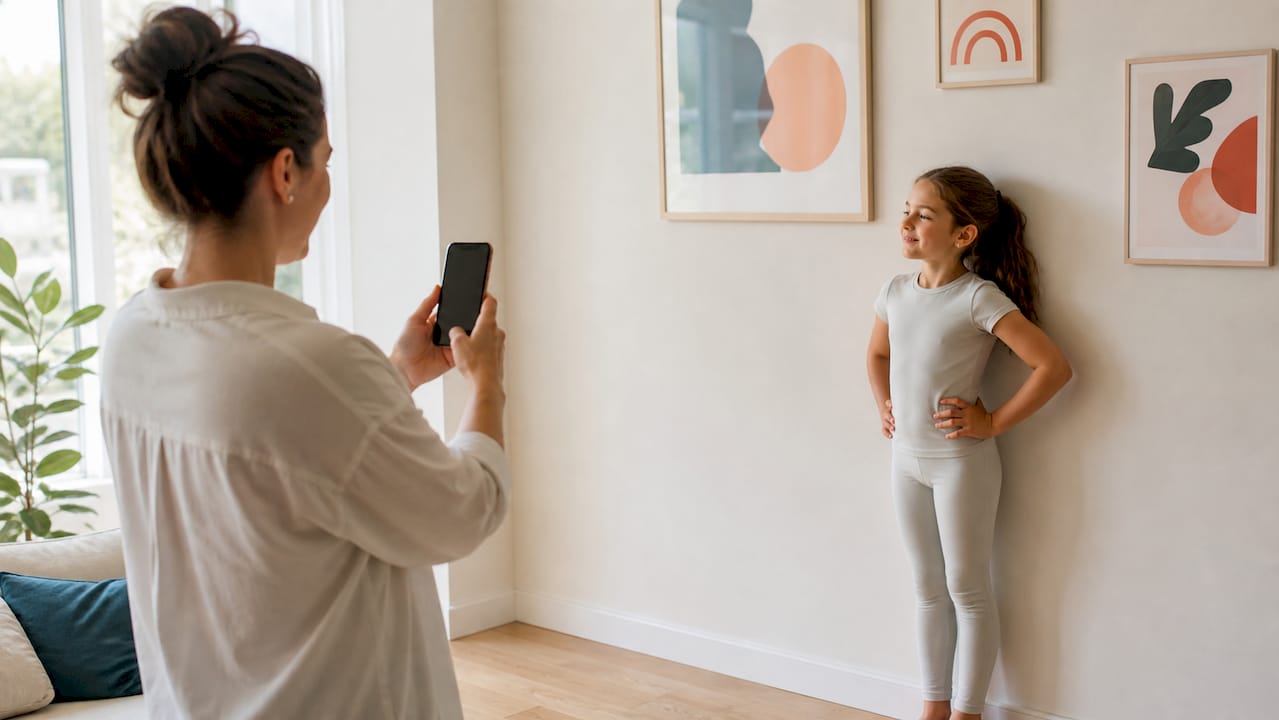
Two properly taken photos produce a reliable profile; two poorly taken ones produce noise. The front photo captures width measurements like chest and hip. The side photo captures depth and posture. Both are needed.
Step-by-step photo guide:
Wear form-fitting clothing, leggings and a fitted top, not jeans or a hoodie.
Stand against a plain, single-color wall with good natural or overhead lighting.
Place your phone on a stable surface at hip height, roughly 6–8 feet away.
Stand with feet hip-width apart, arms slightly away from your sides.
Look straight ahead, shoulders relaxed, no arching or slouching.
For the side photo, turn 90 degrees and repeat the same posture.
Check that your full body from head to toe is visible in the frame before shooting.
Pro Tip: Ask a friend to take the side photo. Self-timer shots often result in a slightly twisted posture that throws off depth measurements.
Pro Tip: Wipe your phone lens before shooting. A smudged lens softens the silhouette edges the algorithm needs to detect landmarks accurately.
Common mistakes: cropped feet or head, a patterned or cluttered background, baggy clothing that hides your actual shape, and shooting in dim light. Clothme’s perfect fit photo guide includes visual examples of correct versus incorrect setups.
What happens when you shop after creating your profile?
Once your profile is saved, the shopping experience changes at the product level. When you view an item, the platform shows a recommended size alongside a confidence indicator and a side-by-side comparison of your measurements against the garment’s listed dimensions. You can also filter your entire product feed to show only items that match your profile, which removes the need to check size charts item by item.
A typical flow: you select a jacket, the system surfaces your recommended size with a note like “your chest measurement matches the size M chest at 39.5 inches,” and you can see where other measurements land relative to the garment’s range. Industry research shows that size-recommender tools often lift conversion, partly because shoppers feel less uncertain at checkout.
One thing to watch: stretch fabrics and relaxed-fit cuts behave differently from structured garments. If a product description notes significant stretch or an oversized silhouette, factor that into your decision rather than relying on the measurement match alone. For more on converting your measurements to size recommendations, Clothme’s size-data shopping guide walks through the logic.
How accurate is photo-based sizing, and where does it fall short?
Photo-based 2D systems give reliable size recommendations for most everyday garments, but they carry measurable error margins, and a few situations push those limits.
Research on smartphone-based body measurement notes that studies report measurement errors often in the 20–30 mm range for certain circumferences, which is acceptable for standard ready-to-wear sizing but not for bespoke tailoring or medical garments. BBC reporting on fashion’s sizing crisis confirms that photo-based tools are among the practical approaches retailers use to help customers choose sizes, while acknowledging that no digital method eliminates all uncertainty.
Measurement type Typical 2D photo error Practical impact Chest / bust circumference 20–30 mm Minor; usually within one size band Waist circumference 20–30 mm Moderate; check garment waist spec Hip circumference 20–30 mm Minor for most ready-to-wear Inseam / length 10–20 mm Low impact on tops; check for trousers
Practical limitations to know: loose clothing during the photo hides your actual shape; nonstandard postures introduce landmark-detection errors; body shapes underrepresented in training data may see larger errors; and complex anatomical landmarks like a high hip are harder to locate from a 2D image.
For bespoke garments, tailored suits, or medical compression wear, in-person measurement or 3D scanning is the better choice.
What privacy protections should you expect for family fit profiles?
Fit profiles contain sensitive personal data: body measurements for you and your children. Expect any reputable platform to offer account-level encryption, per-profile sharing permissions, a clear data-retention policy, and the ability to delete or anonymize profiles on request.
Before saving family measurements anywhere, ask four questions: Where is the data stored and under what jurisdiction? Who inside the company can access individual profiles? Is measurement data shared with third-party brands or advertisers, and on what basis? Is sharing opt-in or opt-out by default?
U.S. consumers have growing expectations around data control, and platforms that handle children’s data carry additional responsibility under federal guidelines. A privacy policy that answers those four questions directly is a baseline signal of trustworthiness.
How parents use saved family profiles in practice
Saved profiles let one account shop for multiple people quickly and cut the back-and-forth of checking sizes for each family member separately.
Practical use cases:
Birthday and holiday shopping: pull up a child’s profile and filter gift options to items that fit, without measuring them again.
Seasonal clothing swaps: check last season’s sizes against current profiles before buying new items
Sibling hand-me-down checks: compare two profiles to see whether a garment that fits one child will fit another
School uniform bulk buying: filter by each child’s profile and order the right quantities in one session
For the holiday family shopping season, saved profiles are especially useful when buying for kids who are not present.
Maintenance matters. Re-scan children every 3–6 months; kids grow fast enough that a six-month-old profile can be off by a full size. Update adult profiles after significant weight or height changes. Tag each profile with the measurement date so you know when it needs refreshing. For divergent fit preferences within the family, slim-fit versus relaxed, save a fit-preference note alongside each profile rather than relying on measurements alone.
Once returns drop and your wardrobe stabilizes, organizing what you keep becomes easier too. A custom closet system helps store seasonal items efficiently once you stop cycling through returns.
How to get started with a photo-based fitting room in the U.S.
Clothme is available in the United States. The start flow is straightforward: create an account, take your two fit photos following the guide above, save your profile, and your product feed immediately filters to items that match your measurements.
Typical pricing models for photo-based sizing platforms include a free basic profile tier, premium subscription features like advanced filtering or style preferences, and a marketplace commission model where the platform earns on completed purchases rather than charging shoppers directly. Clothme operates as a transaction-based marketplace, so browsing and profile creation carry no upfront cost.
The AI body measurement guide on Clothme’s blog explains the algorithm basics if you want to understand what happens behind the photo upload before you start.
What the data actually shows about families and fit profiles
The conventional wisdom about online sizing tools is that they help a little. The data suggests they help a lot, specifically for families who commit to maintaining accurate profiles.
Shoppers who save a measurement profile and use it consistently stop anchoring on label sizes. That shift matters because only 1% of shoppers report consistent sizing across brands, which means label sizes are essentially guesses. A profile tied to actual garment dimensions is a different category of information.
The pattern that shows up repeatedly: parents see the biggest return-rate drop not in the first purchase but in the second and third, once they trust the profile enough to order one size instead of two. The first month is about calibration. Expect one or two profile refinements as you learn which photo angles work best for your body shape. After that, the profile stabilizes and the shopping experience genuinely speeds up.
Clothme gives your family one place to shop by fit, not by guesswork
Families who return clothing most often share one problem: they are shopping by label size across brands that define sizes differently. Clothme solves that at the source. Upload two photos, generate a precise measurement profile, and every product you see is already filtered to your fit. Save a separate profile for each family member and shop for everyone from one account.
The platform matches your measurements against actual garment dimensions across participating brands and boutiques, shows a confidence indicator at the product level, and lets you filter your entire feed by any saved profile. Privacy controls let you manage who can access each profile and delete data on request. The fit-photo guide is built into the onboarding flow so your first profile is accurate from the start.
Create your free fit profile on Clothme and see which items in your size are available right now.
Sources
A study of consumer willingness to adopt two-dimensional anthropometric measurement systems
The smart body concept as a demonstration of the overarching utility and benefits of 3D avatars in retail, health and wellbeing: an accuracy study of body measures from 3D reconstruction
Can technology fix fashion’s sizing crisis?
The true cost of apparel returns: alarming return rates require loss-minimization solutions