3 At Home Tests to Choose Breathable Summer Fabrics by Weave, GSM, Fit
Linen wins for sustained daytime heat, thanks to hollow fibers that move air and dry fast. Lightweight open weaves like voile, muslin, and chambray handle everyday errands and office wear. Lyocell (Tencel) is the pick for humid climates because it absorbs moisture without clinging. Featherweight silk suits evenings in air-conditioned rooms, and fine merino works as a surprisingly good base layer. Weave and fabric weight matter as much as the fiber itself.
TL;DR:Linen remains the top choice for heat resilience due to its hollow fibers, moisture absorption, and quick drying, despite wrinkling issues.
Open-weave cotton fabrics like voile and muslin allow better airflow, with breathability depending heavily on weave and weight, not just fiber.
Lyocell (Tencel) outperforms other fibers in humid environments because it absorbs moisture efficiently and stays stronger when wet.
Proper fit significantly impacts fabric breathability; loose styles enhance airflow, while tight cuts trap heat and reduce cooling.
Natural fibers such as linen, cotton, and hemp are more skin-friendly for sensitive skin and offer a lower environmental footprint compared to synthetics like polyester and acrylic.
Clothme
Find Summer Fits That Work
ClothME helps you find clothing sizes tailored to body shape, style, color, and fabric preferences, without guesswork.
Explore ClothME
Table of Contents
Breathable Summer Fabrics: What Works and Why
Not every “summer fabric” earns the label. Some cottons feel stifling by 10 a.m., while a well-woven linen shirt stays wearable through a heat advisory. The difference comes down to fiber structure, weave, and weight, not just what’s printed on the tag.
Linen remains the standard for sustained heat. Its fibers come from the flax plant and are naturally hollow, which lets air pass through the yarn instead of just around it. That structure also lets linen absorb close to 20% of its weight in moisture before it feels damp against the skin, and it dries faster than almost any other natural fiber. The trade-off is obvious the moment you sit down in it: linen wrinkles hard, and its slightly stiff, textured hand isn’t for everyone. If you can live with a rumpled look, it’s worth the discomfort trade.
Lightweight cottons cover a wider range than most shoppers realize. Voile, muslin, chambray, and seersucker are all cotton, but they behave nothing alike depending on how tightly they’re woven. A dense cotton poplin can trap heat almost as badly as a synthetic blend, while an open-weave voile lets air move freely. Breathability here comes down to weave and weight more than the fiber label alone, according to REI’s fabric guidance. If durability matters, look for long-staple cotton. It resists pilling and holds up to repeated summer washing better than short-staple varieties.
Lyocell (often sold as Tencel) and viscose/rayon are both regenerated cellulose fibers, made from wood pulp but processed differently. Lyocell has a fibrillar surface that wicks moisture efficiently and, unlike rayon, tends to stay stronger when wet. Rayon drapes beautifully and feels cool against skin, but it can stretch or weaken with heavy sweat exposure, which makes it better suited to evening wear or low-activity days than to a full day of yard work.
Featherweight silk breathes well and looks polished, which is why it shows up so often in summer eveningwear. It’s less forgiving in full sun or high humidity: silk shows perspiration marks quickly and needs gentler care than cotton or linen.
Merino and tropical wool sound like a contradiction for summer, but fine-count versions genuinely work. Merino regulates temperature and resists odor in ways synthetic fabrics can’t match, and tropical wool’s open, springy weave holds its shape while still allowing airflow. Both make more sense as tailored pieces or travel layers than as your go-to T-shirt fabric.
Hemp, often blended with linen, adds durability and a similarly airy structure, aging well through repeated summer wear.
A quick warning on synthetics: heavy polyester and acrylic are poor everyday choices. They’re engineered to wick moisture for athletic performance, but in still air, synthetics often trap heat and odor rather than releasing it. Save them for the gym, not the office.
Linen: best for sustained dry heat, fastest drying, wrinkles easily
Open-weave cotton (voile, muslin, chambray, seersucker): everyday comfort, easy care
Lyocell/Tencel: strong wet performance, ideal for humidity
Viscose/rayon: cool drape, weaker when wet, better for low-sweat occasions
Silk: breathable in cooled interiors, shows perspiration marks
Fine merino/tropical wool: temperature regulation and odor resistance for tailored pieces
How Weave and Fabric Weight Decide If It Breathes
Fiber type only tells half the story. A “breathable” fiber woven too tightly traps heat just as effectively as a bad synthetic. Open weaves leave visible gaps between yarns, letting air pass through the fabric itself instead of pooling against your skin.
Weight matters just as much. Fabric weight is measured in grams per square meter (GSM), and summer fabrics generally perform best between roughly 80 and 200 g/m². Below that range, fabric can feel almost sheer. Above 200 GSM, even a natural fiber starts to feel more like a winter piece.
Fabric names give useful shortcuts once you know how to read them. Voile and muslin signal an open, breathable construction, while poplin and twill point to denser weaves built for structure over airflow.
Three checks work well while shopping in person:
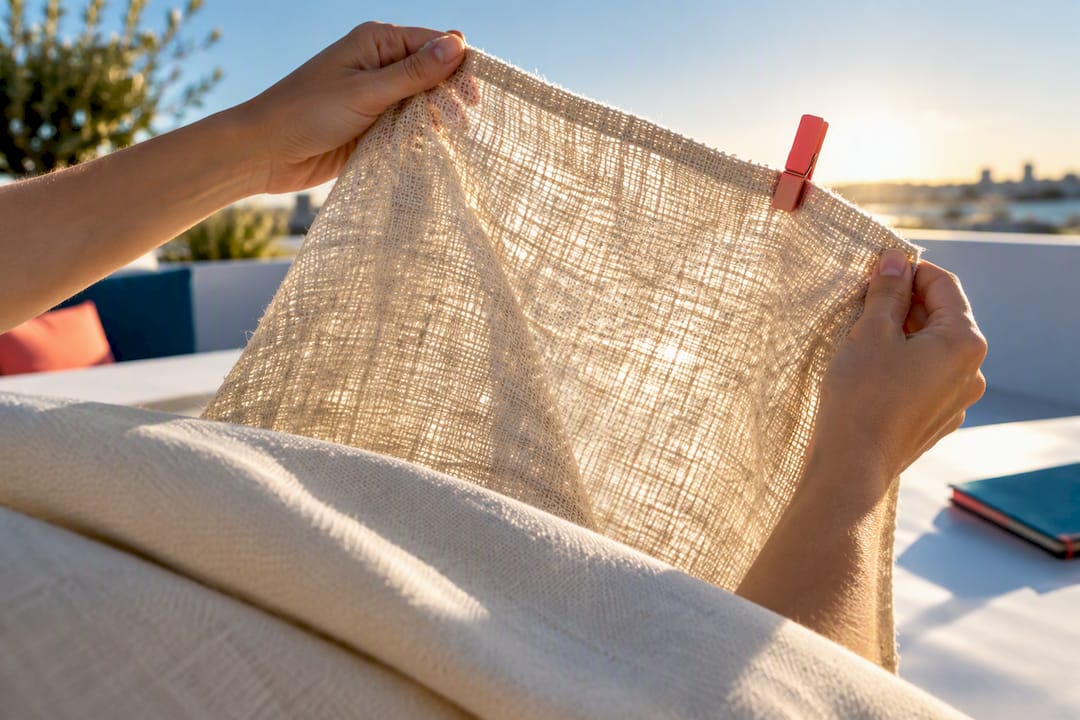
Hold the fabric up to a light source. More light passing through generally means better airflow, a simple test recommended by REI.
Try breathing through a folded section of the fabric. If air moves easily, so will heat.
Check the tag for weave name and GSM, when listed, rather than relying on fiber content alone.
Finishes can undo good fiber choices, too. Water-resistant coatings and easy-care resin treatments (the kind that reduce wrinkling) work by sealing fibers slightly, which also reduces airflow.
Pro Tip: A shirt that feels stiff and slightly papery straight off the shelf has likely been treated with a wrinkle-resistant finish. That crispness usually means less breathability, not more quality.
Matching Fabric to Climate and Activity
Dry heat and humid heat call for different fabrics, even at the same temperature. In dry climates, evaporative cooling works in your favor. Sweat evaporates quickly off the skin, so linen and tropical wool tailoring perform well because they let that process happen unobstructed.
Humidity changes the math. Sweat lingers on skin instead of evaporating, so fabrics that pull moisture away from the body and dry fast matter more than fabrics that simply feel light. Lyocell, open-weave cotton, and lightweight modal all handle sustained humidity better than a cotton jersey tee, which tends to cling and stay damp.
Dry heat: linen shirts, tropical wool trousers, open cotton weaves
Humid heat: Tencel, lightweight modal, voile, muslin
Active or athletic use: engineered wicking synthetics designed specifically for sweat management
Everyday social settings: natural fibers, which feel and look better over a full day
Travel: linen-cotton or Tencel blends resist wrinkling and pack down well
For workouts or anything sweat-intensive, purpose-built synthetics still make sense. That’s the context they were engineered for. Save the natural fibers for the rest of your closet.
Care, Blends, and What to Check Before You Buy
Blends solve real problems. A 75/25 linen-cotton mix keeps much of linen’s airflow while softening its texture and cutting down on wrinkles. Tencel-cotton blends work similarly, adding durability without sacrificing much breathability. The rule of thumb: once polyester content climbs past roughly 30%, you start losing the natural fiber’s cooling benefit.
Care habits change performance, too. Over-drying on high heat breaks down fibers and stiffens hand-feel over time; air-drying preserves both softness and airflow. For fabric choices tied to daily routines and packing, matching care requirements to your actual laundry habits avoids a closet full of pieces that need more attention than you’re willing to give.
Before buying, check:
Fiber percentages listed on the tag or product page
Weave name (voile, chambray, poplin) for a quick breathability signal
GSM, when the brand lists it
Product photos for translucency and drape
Pro Tip: Hold a listing photo up mentally against a bright window. If the model’s silhouette shows through the fabric in the photo, that’s a strong sign the weave is open enough to breathe.
Why Fit Changes How a Fabric Actually Performs
A breathable fabric cut too tight stops breathing altogether. Fabric needs space to let air circulate near skin, so an ill-fitting shirt undermines even the best linen or Tencel piece. A photo-based sizing tool can build a size profile from two uploaded photos, no tape measure required, and lets you save profiles for family members so everyone gets accurate recommendations. Pairing the right fabric with the right fit is what actually keeps you cool.
Can Summer Fabrics Trigger Skin Irritation?
Fabric choice matters almost as much for sensitive skin as it does for temperature control. Natural fibers like linen and cotton are generally well tolerated because they contain no synthetic resins and allow sweat to evaporate instead of sitting against skin, which reduces the friction and moisture buildup that trigger irritation in some people.
Synthetic fabrics carry more risk for reactive skin. Polyester and acrylic trap heat and moisture, creating a warm, damp environment that can aggravate conditions like eczema or heat rash. Some finishing treatments add another layer of risk. Wrinkle-resistant resin finishes, common on easy-care cotton and cotton blends, sometimes contain formaldehyde-releasing compounds that cause contact dermatitis in sensitive individuals.
Wool sits in a middle category. Fine merino is generally gentler than coarse wool, but anyone with a wool sensitivity should test a small patch before committing to a full garment. Dyes matter too. Darker, more heavily processed colors carry a higher chemical load than undyed or lightly dyed fabric.
If you deal with sensitive skin, look for undyed or naturally dyed linen and cotton, skip permanent-press finishes where possible, and wash new garments before wearing them to remove residual processing chemicals. Clothme’s guide to fabric choices for sensitive skin walks through specific fiber recommendations and laundering habits that reduce reaction risk further.
Is Linen More Sustainable Than Synthetic Summer Fabrics?
Fiber origin drives most of the environmental difference between summer fabrics. Linen comes from flax, a crop that generally needs less water and fewer pesticides than cotton, and it biodegrades at the end of its life instead of shedding microplastics into water systems. Hemp shares similar advantages, growing quickly with minimal chemical input while producing a durable, breathable fiber.
Cotton’s footprint depends heavily on how it’s grown. Conventional cotton is water and pesticide intensive, while organic cotton programs reduce chemical use but still require significant irrigation. Lyocell occupies interesting middle ground: it’s made from wood pulp through a closed-loop process that recovers and reuses most of its solvents, giving it a notably lower environmental footprint than conventional rayon production.
Synthetic fabrics carry the most persistent downside. Polyester and acrylic are petroleum-based, don’t biodegrade, and shed microplastic fibers with every wash cycle, fibers that eventually reach oceans and waterways. Choosing synthetics only where their performance properties genuinely matter, like high-intensity athletic wear, limits that impact to situations where it’s actually justified.
Durability plays into sustainability just as much as fiber origin. A linen shirt that lasts a decade has a lower lifetime footprint than five seasons of cheap polyester blends replaced annually. Clothme’s guide to shopping more sustainably covers how to weigh durability against upfront cost when building a wardrobe meant to last.
What Do Breathable Summer Fabrics Cost?
Price ranges widely across fiber types, and the gap often comes down to processing complexity rather than raw material cost. Cotton sits at the accessible end. Basic voile and muslin pieces are widely available at moderate prices, since cotton is one of the most heavily produced fibers in the world.
Linen carries a noticeably higher price tag, largely because flax processing is more labor-intensive than cotton harvesting, and quality varies a lot between mass-market and European-milled linen. Expect to pay a premium for linen that drapes well and holds up over years of wear rather than pilling or thinning after a season.
Lyocell and Tencel land in the middle of the range, generally pricier than basic cotton but more accessible than high-end linen. The closed-loop manufacturing process adds cost, but not as dramatically as flax cultivation and processing does.
Silk and fine merino sit at the top of the price spectrum. Silk’s cost reflects labor-intensive production, and quality merino wool involves specialized breeding and finer, more delicate processing than standard wool. Both are best treated as investment pieces for specific occasions rather than everyday basics.
Blends often offer the best value for money. A linen-cotton or Tencel-cotton blend costs less than a pure linen or pure Tencel piece while retaining most of the breathability benefit, which makes blends a practical entry point if you’re building a warm-weather wardrobe on a budget rather than replacing it all at once.
A Simple Summer Wardrobe Blueprint
Build around a few linen pieces for daytime heat, several lightweight cotton basics for everyday wear, one lyocell or silk piece for evenings, and a fine merino layer if your climate swings cool. Accept the wrinkles. That’s the trade for staying comfortable.
— admin
Match Your Fabric Picks to a Fit That Actually Works
Buying the right fabric only solves half the problem if the cut is wrong. A loose linen shirt in the wrong size traps less airflow than a properly fitted one, and a too-tight cotton top clings exactly where you don’t want it to.
Clothme’s free size tool builds your size profile from two uploaded photos, no measuring tape, no guesswork, and no more ordering three sizes to find the one that fits. Save profiles for every family member so summer shopping for kids doesn’t turn into a returns nightmare. From there, you can browse curated picks filtered by the fabric preferences covered in this guide, whether that’s open-weave cotton for daily wear or a lyocell piece for humid travel. Head to Clothme and set up your free profile before your next summer order.
Sources
FAQ
What Fabric Is Best to Wear in Hot Weather?
Linen is the top overall choice for sustained heat because its hollow fibers promote airflow and fast drying. Lightweight open-weave cotton and lyocell are strong runner-ups depending on humidity and activity level.
What’s the Best Fabric for Hot and Humid Weather?
Lyocell (Tencel) tends to outperform other fibers in humidity because it absorbs moisture and dries quickly without clinging to skin. Open-weave cotton and lightweight modal are solid alternatives when lyocell isn’t available.
What Fabric Can You Breathe Through?
Open-weave fabrics like voile, muslin, and gauze let visible light and air pass through the weave, which is the simplest test for breathability. Tightly woven fabrics, even in a breathable fiber like cotton, block much of that airflow regardless of material.
Does Fit Affect How Breathable a Fabric Feels?
Yes. A garment cut too tight compresses fabric against skin and blocks the airflow the weave is designed to provide. A photo-based size tool helps match the right cut to your body so breathable fabrics actually perform as intended.
Is Cotton or Linen Better for Summer?
Linen generally wins for sustained heat and fast drying, while lightweight cotton wins for everyday comfort, easy care, and lower cost. The better choice depends on whether you prioritize maximum airflow or minimal upkeep.