Parents: Five Minute Family Profiles for Better Computer Vision Sizing
Computer-vision sizing turns two phone photos into a product-specific size recommendation, mapping your body’s shape to a garment’s actual construction instead of a generic size chart. Saved family fit profiles let parents store that data for every household member, so recommendations get reused instead of re-guessed. ClothME builds its size matching around this two-photo, saved-profile approach.
TL;DR:Body shape and posture captured from front and side photos improve size recommendations more than single measurements, especially when garment construction details are included.
Accuracy tends to decline with baggy clothing, poor lighting, or unfamiliar brands lacking complete size data, limiting the system’s reliability.
Saving multiple family profiles allows quick reuse for growing children and simplifies gifting, reducing the need for repeated measurements.
Most systems take about five minutes per person to set up, requiring properly fitted clothing and well-lit photos for best results.
Trustworthy sizing services transparently state data privacy policies, offer profile management, and incorporate real product data to improve recommendation accuracy.
Clothme
Shop With Your Family’s Sizes Saved
ClothME uses two photos to create personalized size profiles, helping parents find clothing matches for each family member with less guesswork.
Explore ClothME
Table of Contents
How Does Computer-Vision Sizing Actually Work?
The process starts with two photos: one from the front, one from the side. That pairing matters more than most shoppers realize. A single circumference number, like a waist measurement, tells you almost nothing about drape, posture, or how fabric sits on a body. Front-and-side pairs capture proportion and shape ratios, which is why Zalando’s size and fit system relies on the same two-angle capture rather than a single shot or manual entry.
From there, the algorithm extracts body geometry, shoulder width, torso length, limb proportions, and posture, and maps it against garment construction data at the individual product level. That’s a meaningful shift from “size medium” to “this specific shirt, in this cut, in this size.” When brands feed in construction details like seam placement, chest width at the seam, and fabric stretch, the system can recommend an exact SKU size rather than a generic label, which is where first-try fit improves the most.
Behavioral signals sharpen the picture further. Amazon’s fit tools, for instance, synthesize reviews, size charts, and past purchase behavior alongside product data to flag when a specific item tends to run small or large. Photo quality still drives the outcome more than any other input: fitted (not baggy) clothing, even lighting, a plain background, and a neutral standing posture all measurably change how accurately the system reads your silhouette. For a deeper technical walk-through of what the camera actually captures, ClothME’s guide to AI body measurement apps breaks down the capture process step by step.
How Accurate Is Photo-Based Sizing, Really?
A 2025 study on single-camera vision systems found that measurements generated from one camera can rival manual tape-measure accuracy while cutting the time needed to capture them. Zalando reports its combined photo-and-garment-data approach prevented roughly 8% of size-related returns in 2025. That’s a real number, but it’s not the whole story.
Accuracy drops in specific, predictable situations: baggy or loose clothing in the photos, poor or uneven lighting, and “cold start” brands the system has never scored before. Complex drape, think flowy dresses or heavily structured jackets, is still hard to model from two flat photos. On the garment side, results only get as good as the SKU data behind them; a retailer with incomplete or inconsistent size charts limits what any algorithm can promise. Industry analysis on fashion ecommerce makes the same point: no amount of computer vision fixes a garment page missing basic measurements. Look for model photos matching your body type, dimension overlays on the product page, and review mentions of fit before trusting a recommendation outright.
Why Family Fit Profiles Matter for Parents
A family fit profile stores three things per person: a body geometry signature, stated fit preferences (snug, relaxed, true-to-size), and purchase history. Once that exists, the system doesn’t start from zero every time someone in the household needs new clothes.
That reuse matters most for parents. Kids grow in bursts, not straight lines, so a profile that updates against real purchase outcomes catches a growth spurt faster than a parent tracking it by memory. Hand-me-downs get easier to plan when you can compare siblings’ saved geometry side by side instead of guessing whether last year’s coat will fit this year’s kid. Gift shopping for a niece or nephew stops being a coin flip once someone else’s profile is on file.
Retailers benefit too. Merchant guidance on fit profiles shows that combining a body model, fit preference, and purchase history lowers repeat-return rates and sharpens future recommendations, a pattern that holds whether the shopper is buying for themselves or for three kids at once. ClothME’s approach to saved personalized size data is built around exactly this kind of reuse.
How Do You Set Up Photo-Based Sizing for Your Family?
Getting a usable profile takes about five minutes per person, and most of the accuracy comes down to how the photos are taken.
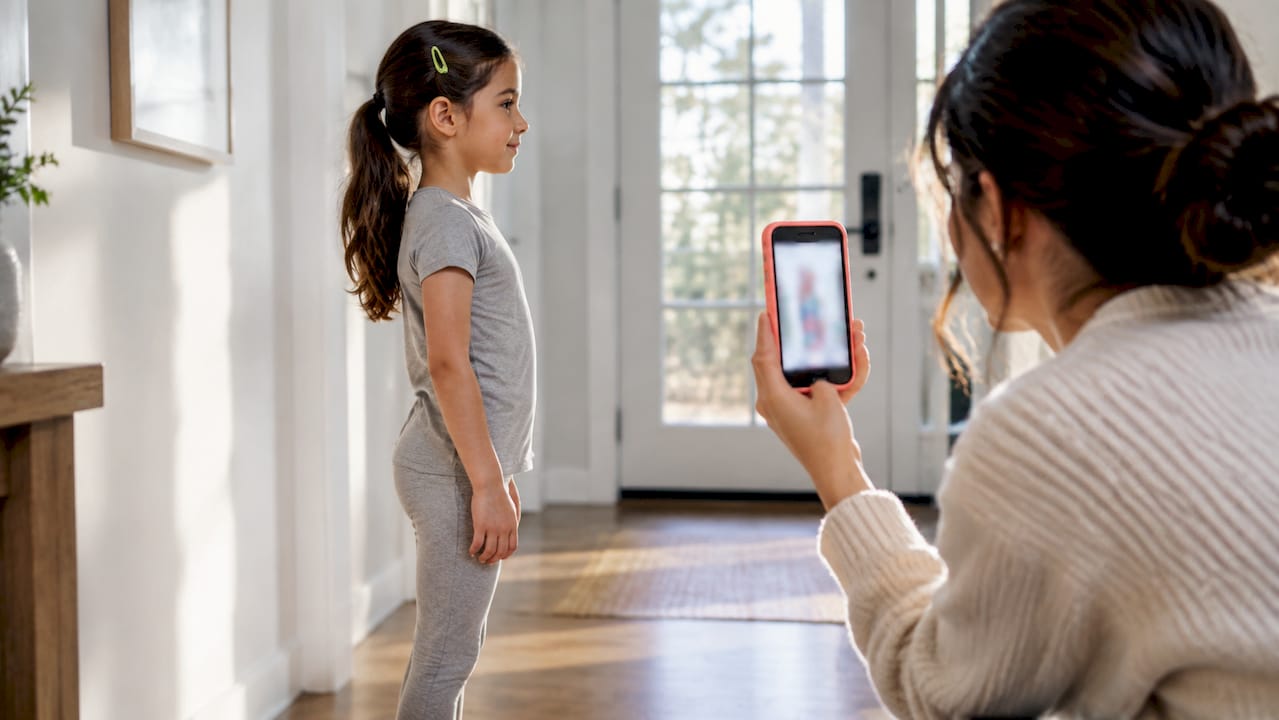
Prep the shot. Wear fitted clothing, not loose layers, stand against a plain background, and have the camera positioned at chest height, roughly six to eight feet back.
Upload front and side photos. The system extracts your geometry from both angles, so skipping the side shot weakens the read on posture and depth.
Review the inferred measurements. Check that shoulder width and torso length look reasonable before saving; a bad photo often produces an obviously off number.
Set a fit preference and save the profile. Name it by family member so you can switch between profiles in seconds.
Apply it at checkout. Recommendations populate automatically, but always cross-check against the garment’s own measurement chart for unusual cuts or heavily structured pieces.
Update after growth spurts. Log outcomes (too tight, too loose, perfect) so the profile self-corrects over time.
Pro Tip: Retake photos every season for growing kids. A profile that’s six months stale on a ten-year-old is often more wrong than no profile at all.
What Should You Check Before Uploading Family Photos?
Before creating a child’s profile, verify how the photos and geometry data are actually stored, on-device only, or synced to a cloud server, and how long that data is retained. A trustworthy service states this plainly rather than burying it in generic legal language.
Check whether your data feeds personalization only or gets folded into aggregated analytics you didn’t sign up for, and confirm you can delete or export a profile on demand. For children specifically, look for explicit parental consent controls, not just an age checkbox. Baseline security signals worth confirming: TLS encryption on the upload, a clearly written photo-handling policy, and a privacy policy you can actually find and read in under two minutes.
What Makes a Sizing Service Worth Trusting?
Not every sizing tool deserves equal confidence. A short checklist separates the ones worth your time from the ones guessing along with you.
Accuracy evidence: Does the provider point to published studies or real pilot results, and does it use SKU-level garment data rather than generic size labels?
Family features: Can you save multiple profiles, edit them easily, and set parental controls for kids’ accounts?
Integration and user experience: Does the recommendation apply automatically at checkout, with clear fit notes and measurement overlays you can actually verify?
Transparency: Is the data retention policy visible, can you delete or export your profile, and are security practices stated rather than implied?
A service that’s vague on all four is a service asking for blind trust.
Why Saved Fit Profiles Are the Practical Next Step
Saved profiles change family shopping less through raw accuracy and more through friction removal. You stop re-explaining your kid’s build every single time. That said, no photo-based system replaces a garment’s own measurement chart, especially for structured or heavily draped pieces, so smart shoppers use both. The technology is a strong assist, not an oracle, and ClothME’s whole product is built on treating it that way.
— admin
Get Product-Specific Sizes With ClothME’s Family Profiles
Clothme is the alternative to size-chart guesswork: upload two photos once, and you get product-specific size recommendations instead of a size label that might mean nothing for a given brand’s cut.
Some services let you save a fit profile for every member of your household, so shopping for your partner, your kids, or a gift for your sister doesn’t start from scratch each time. Recommendations can be matched to individual products rather than generic size ranges, which addresses a common gap in many retailers’ size charts. If you’re tired of ordering two sizes just to find out which one fits, create your family profiles at ClothME and see product-specific size picks the next time you shop.
Sources
FAQ
What Is Computer-Vision Sizing?
It’s a method that analyzes two photos, front and side, to extract body geometry and match it against a specific garment’s construction data, producing a product-level size recommendation instead of a generic size label.
How Accurate Are Photo-Based Size Recommendations?
Single-camera systems have shown accuracy competitive with manual measurement in a recent study, though results weaken with baggy clothing, poor lighting, or brands with incomplete size data.
Can I Save Sizing Profiles for My Kids?
Yes. Services like ClothME let you save a separate fit profile per family member, storing body geometry and fit preference so you’re not re-measuring every time you shop.
Does This Really Reduce Returns?
Zalando reported its combined photo-and-garment-data approach prevented about 8% of size-related returns in 2025, and merchant guidance links saved fit profiles to lower repeat-return rates generally.
Is It Safe to Upload Photos for Sizing?
Check how photos are stored, whether data stays on-device or in the cloud, and whether you can delete or export your profile; a trustworthy service states its retention policy and security practices clearly.