How to Measure Your Neck Size for a Shirt Collar
To measure your neck size, wrap a soft tape around the base of your neck, just below the Adam’s apple, keep it level and snug, then add about half an inch and round to the nearest half inch. That number is your collar size. The tape reading alone is not. Most wrong-size shirts come from skipping that last step or from measuring too high on the neck.
This guide covers the full routine, a conversion from inches to centimeters, a fit check you can do in a mirror, and what to do when two brands give you two different answers. If you shop for a partner or a growing kid, there is also a way to keep every size in one place with our Free Size Tool, which builds a size profile from two photos instead of a tape.
Clothme
Keep Every Family Size in One Profile
ClothME creates personalized size profiles from two photos, helping you shop for children and family members without guessing between brands.
Visit
TL;DR
Measure at the base of the neck, below the Adam’s apple, with the tape level and snug, not tight.
Add about 1/2 inch to the snug reading and round to the nearest half inch. Do this instead of, not on top of, the finger-under-the-tape trick.
Check the result: with the top button fastened, two fingers should slide in flat between collar and neck.
Collar sizes drift by about half a size between brands, so treat your number as a starting point and keep it with your other sizes.
Children’s necks change quickly, so re-measure before each season’s shopping.
Table of Contents
What you need before you start
You need a soft, flexible tape measure. A rigid metal tape will not follow the curve of your neck. If you only have a ruler, use a piece of string, mark where it meets, and measure the string against the ruler. Use a tape that has not stretched: old cloth tapes can add an inch or more to a reading.
A second person makes this easier and more accurate, because looking down at a tape on your own neck tilts your head and changes the result. If you are alone, use a mirror and keep your chin level.
Do not measure over a collar. Take off your shirt or at least open it fully and measure on bare skin.
How to measure your neck, step by step
Stand relaxed with your head level. Look straight ahead. Do not crane your neck, tuck your chin or lift your shoulders.
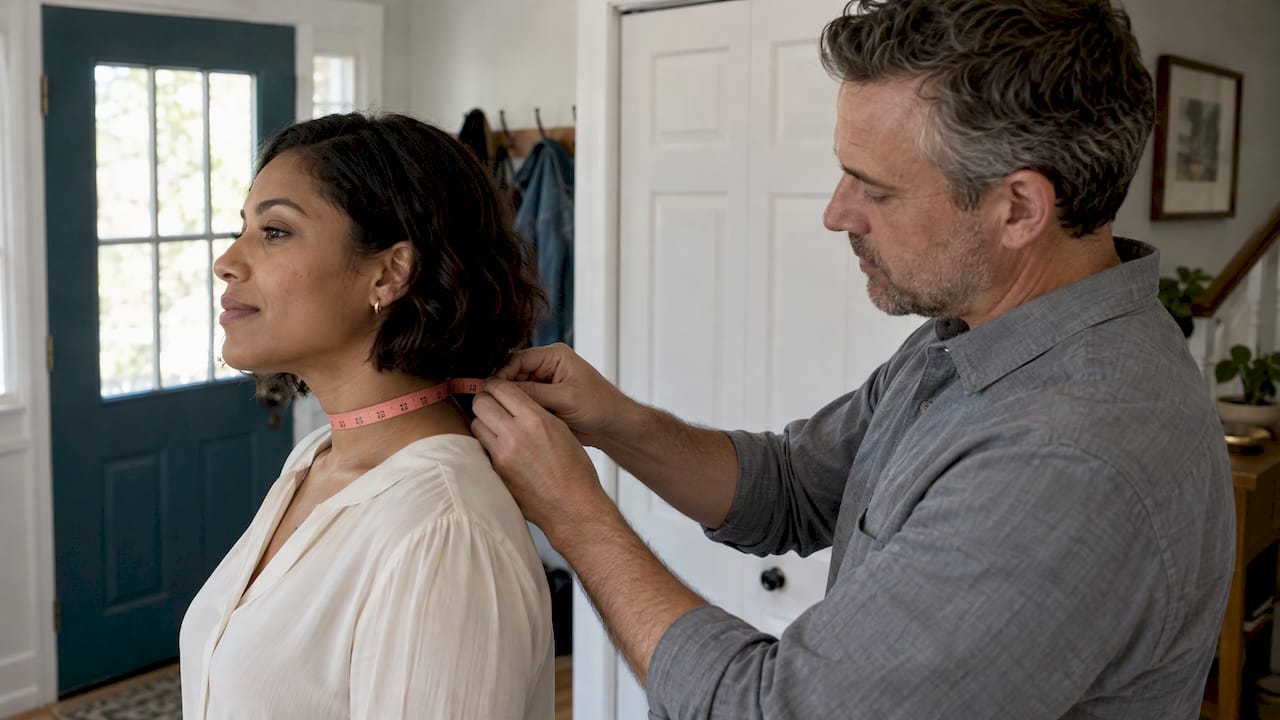
Place the tape at the base of the neck. Wrap it around the point where a shirt collar would normally sit: just below the Adam’s apple at the front and across the base of the neck at the back. TailorGuide’s shirtmaking guide describes the same placement.
Keep the tape level all the way round. It should not climb up at the back or dip at the front. A tilted tape reads long.
Make it snug, not tight. The tape should lie flat against the skin without pressing in.
Read where the tape meets the zero end. Write the number down in inches. If you only have centimeters, divide by 2.54.
Add ease. Add about 1/2 inch to your snug reading, then round to the nearest half inch.
That sixth step is the one people forget. The neck measurement is a body measurement. A collar needs room for you to breathe, swallow and turn your head with the top button done up.
Where it goes wrong
A few habits cause most bad readings, and Nathan Tailors lists them:
Measuring too high. A tape up near the jaw under-reads, sometimes by an inch or two.
Pulling the tape tight. The collar then pinches by the middle of the day.
Forgetting the ease. A 15.5 inch reading means a 16 inch collar, not 15.5.
Tilting your head down. It changes the shape of the neck and the length of the tape path.
Also, do not double up on room. TailorGuide warns against slipping a finger under the tape and then adding half an inch as well: the collar will come out a size too big. Pick one method. We suggest the plain one: snug tape, then add half an inch.
Turning your measurement into a collar size
U.S. dress shirts list collar sizes in inches, usually in half-inch steps. Here are three worked examples:
Snug tape reading Add 1/2 inch Shirt collar size to buy 15 in (38 cm) 15.5 in 15 1/2 15.2 in 15.7 in 16 16.4 in 16.9 in 17
The middle row follows the rule TheSize.net’s shirt chart gives: add 0.5 inch to a snug reading and round up to the next half inch. When you land between sizes, rounding up is the safer choice, particularly if you wear a tie.
Inches, centimeters and letter sizes
European brands list collars in centimeters. Divide by 2.54 to get inches. Fylite’s conversion chart gives two useful examples: a 41 cm collar is 16.1 inches, sold as a 16, and a 43 cm collar is 16.9 inches, sold as a 17.
Casual shirts often use S, M, L instead. TheSize.net maps them roughly like this:
Letter size Collar (inches) Collar (cm) S 14 to 14.5 36 to 37 M 15 to 15.5 38 to 39 L 16 to 16.5 41 to 42 XL 17 to 17.5 43 to 44 XXL 18 to 18.5 46 to 47
Treat that as a guide, not a promise. The same page notes that collar sizes vary by about half a size between brands. For more conversions across the U.S., U.K. and EU, see our size chart comparison and the clothing size conversion chart.
A shortcut: measure a shirt that already fits
If you own a shirt with a collar you like, lay it flat, open the collar and fasten the button. Measure in a straight line from the center of the button to the far end of the buttonhole. Do not measure tip to tip. This gives you a garment measurement, which runs a little larger than your body, so use it to cross-check your result, not to replace it.
Check the fit: the two-finger test
A measurement on paper means little until the shirt is on. With the top button fastened, you should be able to slide two fingers flat between the collar and your neck without forcing them. One finger means the collar is too tight. A whole hand means it is too loose.
A few more things to look for, drawn from TailorGuide’s fit checklist:
The collar should not gape at the back or ride up under a tie knot.
The shoulder seam should sit at the edge of the shoulder bone.
Check with a tie on if you will wear one. A collar that feels fine open can feel very different once a knot sits against it.
For the rest of the shirt, from sleeve length to cuff, our guide on how a dress shirt should fit walks through each point.
Why the same neck size fits differently from brand to brand
You can do all of this correctly and still get a collar that feels off. Brands cut collars differently, use different fabrics and grade their sizes in different ways, so a 16 in one label is not always a 16 in another. We explain the causes in why clothing sizes change from brand to brand.
Shrinkage is part of this too. Some fabrics tighten in the first few washes, and a collar sized without that in mind can end up snug. If you want the details, there is a useful breakdown of how much garment shrinkage to expect and how to allow for it. Our own explainer on what pre-shrunk cotton means covers what a label does and does not promise.
The practical answer is to keep a short record: your neck measurement, your collar size, and which brands fit you at that size. Next time you shop, you start from facts instead of guesses.
Measuring a child’s neck
Parents often need a collar size for a school uniform, a wedding or a holiday photo. The method is the same: soft tape, base of the neck, snug and level, then a little ease. Children wriggle, so measure when they are calm and standing still, and have them look straight ahead.
Two habits help:
Re-measure every time you shop. A neck size from last spring may be a size too small by autumn.
Leave a little room. Fastened collars should still allow two fingers to slide in. Kids tug at tight collars and stop wearing the shirt.
If a tape measure and a restless seven-year-old do not mix, a photo-based profile is simpler, which brings us to what we do.
Our point of view: sizes belong in a profile, not a notebook
Measuring your neck is a good skill to have, and the steps above will get you a reliable collar number. But a collar is only one number among many, and it changes from label to label. Most people do not want to measure their chest, sleeves and neck again every time they open a new shop.
That is why we built ClothME around photos. You upload two photos and we generate a size profile, with no tape measure involved. The profile then filters what you see, so you browse products that match your size along with your style, color and fabric preferences.
Households make the case even clearer. You can save size profiles for family members, so one person can shop for a partner, a teenager or a toddler without asking for numbers each time. For parents, that means fewer guesses on sizes that keep changing. Our aim is fewer returns and fewer size mismatches, for the whole family.
If you still like to measure, keep your neck number alongside your profile. It is a useful cross-check, and it is yours.
the author
Try it for the whole household
If you would rather skip the tape and the arithmetic, our Free Size Tool builds a size profile from two photos. Save one for yourself, one for your partner and one for each child, and your feed shows items that match each person’s size, style, color and fabric preferences.
Start at ClothME and build your first profile. When you want to go deeper on collars, our guides on shirt collar sizing and men’s shirt sizing are the next step. If you are buying a blazer too, see what’s my jacket size.
FAQ
Is a 17 inch neck big for a man?
A 17 inch collar sits in the XL range on TheSize.net’s chart, which lists XL as 17 to 17.5 inches. Whether it is big depends on build and height, and many men wear it comfortably. What matters is that your measured size plus ease matches the collar you buy.
How do I measure my neck without a tape measure?
Use a piece of string or a phone charging cable. Wrap it around the base of your neck where the collar sits, pinch the point where it meets, then lay it flat and measure it against a ruler. Add the same half inch of ease afterward and round to the nearest half inch.
How do I convert a 40 cm neck to a shirt size?
Divide by 2.54: 40 cm is about 15.7 inches. If that is your snug neck reading, adding half an inch gives 16.2, so a 16 or 16 1/2 collar is the usual place to start. Use the two-finger test to choose between them, and size up if you wear a tie.
Should I measure my neck in the morning or evening?
Any time works if you are consistent. One tailoring brand suggests measuring at the end of the day, when the neck is at its widest, and rounding up if you are between sizes. Whichever time you pick, keep the tape level and the head straight.
What if I fall between two collar sizes?
Round up to the next half inch, especially if you wear ties. Then run the two-finger test with the top button fastened. If the collar gapes at the back or leaves a visible space around the neck, go down a half size next time and note it in your records.
Sources
How to Measure Your Dress Shirt Size: Neck and Sleeve, TailorGuide
Shirt Size Chart: Neck, Sleeve and S-XXL Measurements, TheSize.net
How to Measure Neck Size for Dress Shirts and Suits, Nathan Tailors
Garment Dye Shrinkage: How Much to Expect and Plan For, Tekton LA