Men’s Blazer Sizing: How to Find Your Size and Fit
A men’s blazer size is a number, usually your chest measurement in inches, followed by a letter for length: short, regular or long. A 40R is built for a 40-inch chest and an average height. The catch is that every brand cuts its own version of that number, so the label alone never guarantees fit. This guide shows how to read the numbers, measure yourself, handle in-between sizes and avoid the returns that come from guessing. If you would rather skip the tape measure, our Free Size Tool builds a size profile from two photos.
Clothme
Find a Blazer Size That Fits
ClothME uses two photos to build a personalized size profile, helping you navigate inconsistent sizing across clothing brands.
Visit
TL;DR
Blazer sizes are chest-based numbers (36, 38, 40, 42 and so on) plus a length letter: S, R or L.
Measure the fullest part of your chest, under the arms and across the shoulder blades, then compare it to the specific brand’s chart, not a general one.
Shoulders decide everything: if the seam does not sit where your shoulder meets your arm, no tailor can fully fix it.
Between two sizes, compare both in the same cut and a second cut before you rely on alterations.
You can save a size profile for each family member, so one person’s blazer size and a teenager’s growing frame are never guesswork.
Table of Contents
How men’s blazer and suit jacket sizes work
In the US, suit jackets and sport coats use a two-part label. The number is the chest size in inches. The letter is the jacket length, which follows your height. One U.S. menswear chart describes it exactly that way: a chest number followed by S, R, L or XL, with a size 40 mapped to a 39 to 40 inch chest.
So a 42L is a jacket for a 42-inch chest and a tall wearer. A 38S is for a 38-inch chest and a shorter torso.
Length letters: short, regular, long
The letters follow height, roughly. One workwear maker puts Short at 5’3" to 5’7", Regular at 5’8" to 6’0" and Tall at 6’1" to 6’3", and notes that torso and sleeve length also matter. Treat those ranges as a starting point. A 5’9" man with long arms may need a long, and a 6’1" man with a short torso may do better in a regular.
Length changes more than the hem. A long jacket has longer sleeves and a longer back, so the whole garment shifts, not just the bottom edge.
Numbered sizes versus S, M, L
Casual blazers often use letters instead. The conversion is loose, because one letter covers several numbers. One chart groups 34, 36, 38, 40, 42 and 44 into XS, S, M, M, L and L. That means a medium can be a 38 or a 40, which is a real difference across the chest.
If a brand sells in letters, check the chest range printed beside each letter and ignore the letter itself.
U.S. / UK jacket size Typical EU size Typical letter label 38 48 S/M 40 50 M/L 42 52 L 44 54 L/XL
These conversions come from one tailor’s own chart for sizes 38 and 40 and follow the standard two-number step for the rest. Use them to orient yourself. For exact cross-border conversions, our size chart comparison across US, UK and EU goes into more detail.
Why the same size fits differently from brand to brand
Ready-to-wear suiting has no universal sizing standard, so you may need to go up or down a size, or a length, when you change brands. That is why a 40R from one label hangs loose and the same 40R from another pulls across the back.
Three things cause most of the variation:
Body chest versus garment chest. A chart can list the chest the jacket is made for and, separately, the finished garment measurement, which includes room to move. One brand’s classic-fit 40 lists a body chest of up to 40.5 inches and a garment chest of 43.5, while its slim-fit 40 lists 40.5 and 43. Same number, different amount of fabric.
Cut. Slim, tailored, classic and regular are house patterns, and the label is not enough on its own. One size guide shows that measurements differ between models even at the same nominal size, across chest, shoulder, half-waist and length.
Construction. Padding, canvas and lining change how a jacket sits on your shoulders, so two jackets with identical charts can still wear differently.
The practical rule: compare actual garment measurements, and compare them against a jacket you already own and like. Lay your best-fitting blazer flat, measure chest, shoulder and length, and hold those numbers up against the product page.
How to measure yourself for a blazer
You need a soft tape measure, a thin shirt or none, and ideally a second person. Stand relaxed with your weight even on both feet and your arms down at your sides.
Chest
This is the number that sets your size. Run the tape horizontally around the fullest part of your chest, just under the armpits and across the shoulder blades. Keep it level with the floor. Breathe normally, and do not puff your chest, hold your breath or flex. One guide specifically warns that raw body measurements do not always equal the tagged suit size, because jackets are cut with built-in room. Measure twice and use the larger reading if they differ.
Shoulders and sleeves
Shoulder width is hard to measure alone, which is one reason a mirror check beats a tape here. For sleeves, measure from the shoulder seam of a jacket that fits you to the end of the cuff, or have someone measure from the shoulder point to the wrist bone with your arm relaxed.
Height and torso
Your height picks the length letter. Check it against your torso: if your shirts always feel short in the body, lean toward long, and if jackets always cover too much of your hands, lean toward short.
The overarm check
Chest alone can miss bulk in the upper arms and shoulders. One workwear maker advises that if an overarm measurement (taken around the shoulders and arms together) is at least 7 inches larger than the chest, order the next larger blazer size to avoid binding. Broad-shouldered and muscular men should run this check.
For a fuller walk-through of taking measurements, see our size measurement guide and the complete jacket measurement guide.
What a well-fitted blazer looks like
Size on the label matters less than what you see in the mirror. Check these in order.
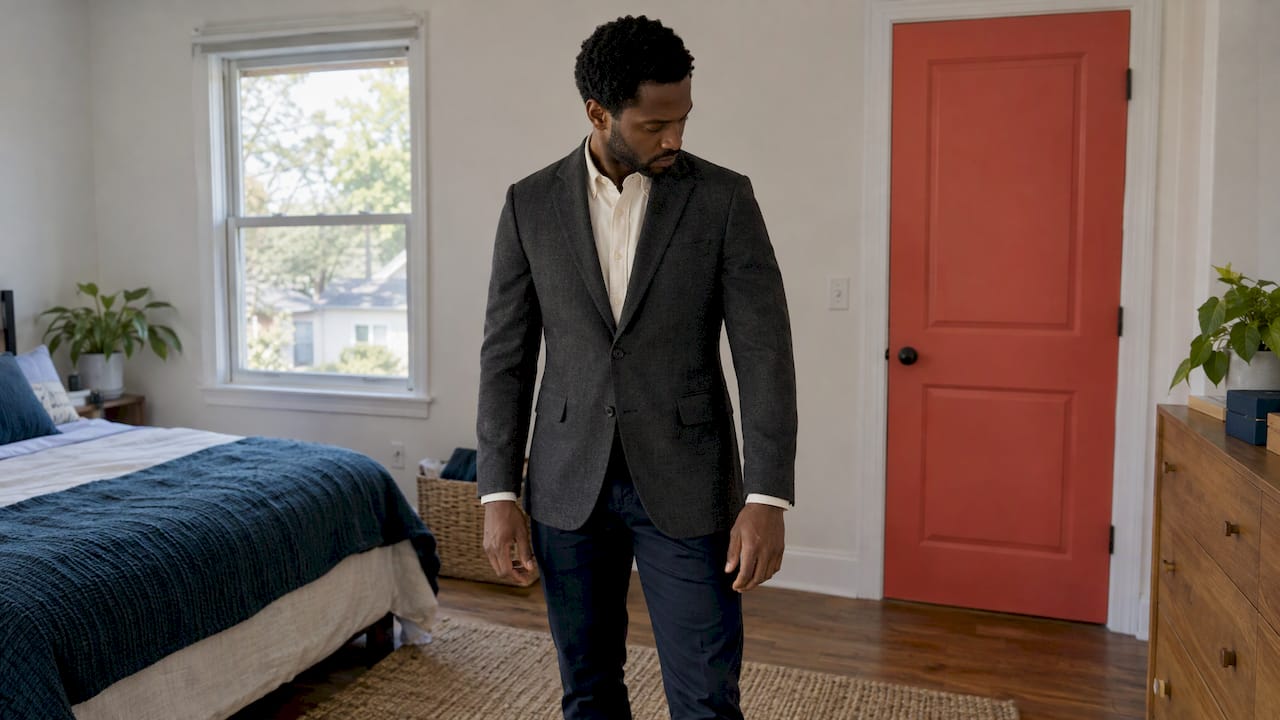
Shoulders. The seam should land where your shoulder meets your upper arm. Tight shoulders crease and restrict movement. Oversized shoulders sag and leave a ridge. Shoulders are the hardest part to alter, so get them right first.
Chest and closure. The front should close without pulling into an X shape and lie flat when buttoned. A deep dent or ripple under the collar points to the wrong size or the wrong cut.
Collar. It should rest against your shirt collar, not lift away from it at the back.
Sleeves. A common guide is about a quarter to half an inch of shirt cuff showing. Many sport jacket guides say the sleeve should end where the wrist meets the hand, or just past it.
Length. The jacket should cover your seat. From the front with your arms relaxed, the hem should reach roughly your second thumb knuckle. Casual blazers can run a little shorter.
Try it on over what you will actually wear. A blazer fitted over a thin shirt can feel tight over a sweater. Stand naturally, check the front, side and back, then sit down and reach forward to see how it moves. Our guide on how a blazer should fit covers shoulders, chest and sleeves in more depth.
When you are between two sizes
This is the most common blazer problem. Say your chest reads 40.5 inches. A 40 may pull and a 42 may sag at the shoulder.
Work through it in this order:
Check the shoulders first. Whichever size fits your shoulders is usually the one to keep. The body of a jacket can be taken in, but shoulders cannot be rebuilt easily.
Compare the neighboring sizes in the same cut. Read garment chest and shoulder width for both, and measure your best jacket against them.
Try a different cut. A slim 42 and a classic 40 can fit the same man differently. Switching cut often solves what switching size does not.
Remember alterations have limits. A tailor can only use the cloth inside the seams, so a tight waist can be let out only so far. One brand’s guide suggests choosing the larger size for comfort and having it tailored if you are between two, but that is that brand’s own advice, not a universal rule.
As a general principle, it is easier to take a jacket in than to let it out. If the shoulders fit and the body is a little roomy, a tailor can usually fix it.
Why online blazer shopping goes wrong
The fitting room does the work that a size chart cannot: it shows shoulders, sleeves and movement at once. Buying online removes that, and men’s tailoring is the hardest category for it, because three numbers (chest, length, cut) have to line up. A man who is a 40R in one brand, a 42R in another and a medium in a third has no reliable number to type into a search box.
The usual workaround is a tape measure and a stack of charts, and that works if you are patient and your measurements are accurate. It breaks down when you are shopping for several people, when the measurement is taken alone, or when every brand lists a different chart format.
Our view: stop converting, start with your own profile
Most blazer returns we hear about start with the same mistake: the shopper trusts one number. A size 40 is not a fact about you. It is a fact about one brand’s pattern.
That is why we built ClothME around a profile of your body rather than a letter on a tag. You upload two photos, no measurements required, and the tool generates a size profile that you can use to see products matched to your fit, style, color and fabric preferences. Our aim is to take the conversion math out of shopping, so the jacket you open is the one you expected.
The same idea matters most in a household. A father, a teenage son and a partner can each have a saved profile, so nobody re-measures every time someone needs a blazer for a wedding, an interview or a school event. For parents, that removes the guesswork of buying a size up and hoping.
Chest numbers, length letters and cut names still matter, and the sections above explain them. A saved profile simply means you do not have to rebuild that reasoning for every brand.
the ClothME team
Try the Free Size Tool
If you are tired of cross-checking charts, the Free Size Tool is the quickest route. Upload two photos, get a size profile and browse items from participating brands and boutiques matched to your preferences. You can save profiles for family members and shop for each of them from the same account.
It is built for exactly this situation: you know roughly what you want, a blazer in a certain color or fabric, and you want to see only the options that suit your frame.
A quick checklist before you buy
Know your chest measurement and your height.
Pick the length letter by height, then adjust for torso and arms.
Read the garment measurements for the exact model, not just the label.
Compare against a blazer you already own and like.
Decide what you will wear under it, and test the fit with that layer.
Choose the size that fits your shoulders, then adjust the body.
If you also buy shirts, our men’s shirt sizing guide helps keep the collar and cuff consistent with your jacket, and the online shopping size guide covers the habits that cut returns across all categories.
FAQ
What size blazer do I need if my chest is 40 inches?
Start with a size 40 and pick the length letter by height. Check the garment chest on the product page, since a 40 can carry anywhere from a trim to a roomy amount of fabric depending on the cut. If you plan to wear a sweater underneath, compare the 40 against the next size up.
Is a blazer size the same as a suit jacket size?
Usually yes in the US: both use a chest number and a length letter. The difference is cut and structure. Sport coats and casual blazers are often cut a little shorter and softer than suit jackets, and some are sold in S, M, L instead of numbers. Always check the chest range behind the letter.
How should the sleeves of a blazer fit?
The sleeve should end around where your wrist meets your hand, leaving about a quarter to half an inch of shirt cuff visible. Sleeves are among the easier parts for a tailor to adjust, so a good shoulder fit with slightly long sleeves is a fine place to land.
What if I am between two blazer sizes?
Choose the size whose shoulders fit, since those are hardest to alter. Then compare garment measurements for both sizes and try another cut before relying on alterations. Remember a tailor can only work with the cloth inside the seams.
Can I find my blazer size from photos?
Yes. Our Free Size Tool is designed to create a size profile from two photos, with no measurements required, and you can save profiles for other family members too.