Parents: Measure Teen Sizes XS–XL (5–18), Then Save a Two Photo Size Profile
A teen size generally maps to youth XS–XL, or numeric 5–18, with chest and height as the two measurements that matter most for picking a size. Measure your teen at home using the steps below, check the numbers against the chart, and confirm against the specific brand’s own chart before you buy. A photo-based tool can also generate a saved size profile from two photos if your teen refuses to stand still for a tape measure.
TL;DR:Youth XL sizes often match adult XS in height and sleeve length but tend to have narrower waist and hip measurements.
Measuring height, chest, waist, hips, and inseam accurately requires a snug tape and can vary significantly between brands.
Size conversions between kids, youth, and adult ranges are inconsistent, making it essential to consult each brand’s specific chart.
Growing teens benefit from sizing up on non-stretch clothing items or re-measuring every few months during active growth to avoid outgrowing garments quickly.
A photo-based sizing tool can save time by generating a size profile from just two images, reducing guesswork and returns during repeat shopping.
Clothme
Find Your Teen’s Size More Easily
ClothME creates a personalized size profile from two photos, helping parents find children’s clothing sizes without repeated measuring.
Try ClothME
Table of Contents
What Is a Teen Size Guide Based On?
A teen size guide works off two numbers: height and chest circumference. Everything else, waist, hips, inseam, gets layered on top once you know where your teen lands on those two measurements. Youth sizing runs on a letter scale (XS, S, M, L, XL) that roughly parallels a numeric scale (5 through 18), and most brands anchor their charts to height and chest first because those two dimensions change the least depending on how a kid is standing or what they ate for lunch.
Here’s a sample chart built from common youth ranges. Treat it as a starting point, not gospel. It’s a good gut check before you dig into brand’s own page.
Youth Size Numeric Height (in) Chest (in) Waist (in) Hips (in) XS 5/6 approximately 45 inches approximately 24 inches approximately 21 inches approximately 25 inches S 7/8 approximately 48 inches approximately 26 inches approximately 22 inches approximately 27 inches M 10/12 approximately 52 inches approximately 28 inches approximately 24 inches approximately 29 inches L 14/16 approximately 58 inches approximately 31 inches approximately 26 inches approximately 32 inches XL 18 approximately 62 inches approximately 34 inches approximately 29 inches approximately 35 inches
A few things trip people up here. A youth XL often matches an adult women’s XS or a men’s small in length, but the waist and hip measurements usually run narrower than adult cuts built for a fully developed frame. That’s why a 14-year-old can wear a youth large in one brand and an adult small in another without anything being “wrong” with the sizing.
Youth XL and adult XS often overlap in height and sleeve length but usually differ in waist and hip room.
Brands cutting for younger teens (ages 11 to 13) tend to run narrower through the shoulder and chest than brands marketing to older teens, even at the same labeled size.
This chart was built by cross-referencing common ranges from major youth apparel charts, including Nike’s boys’ size chart and Under Armour’s youth tops chart, both of which publish height, chest, waist, and hip breakdowns for youth sizes.
How Do You Measure a Teen for Clothing?
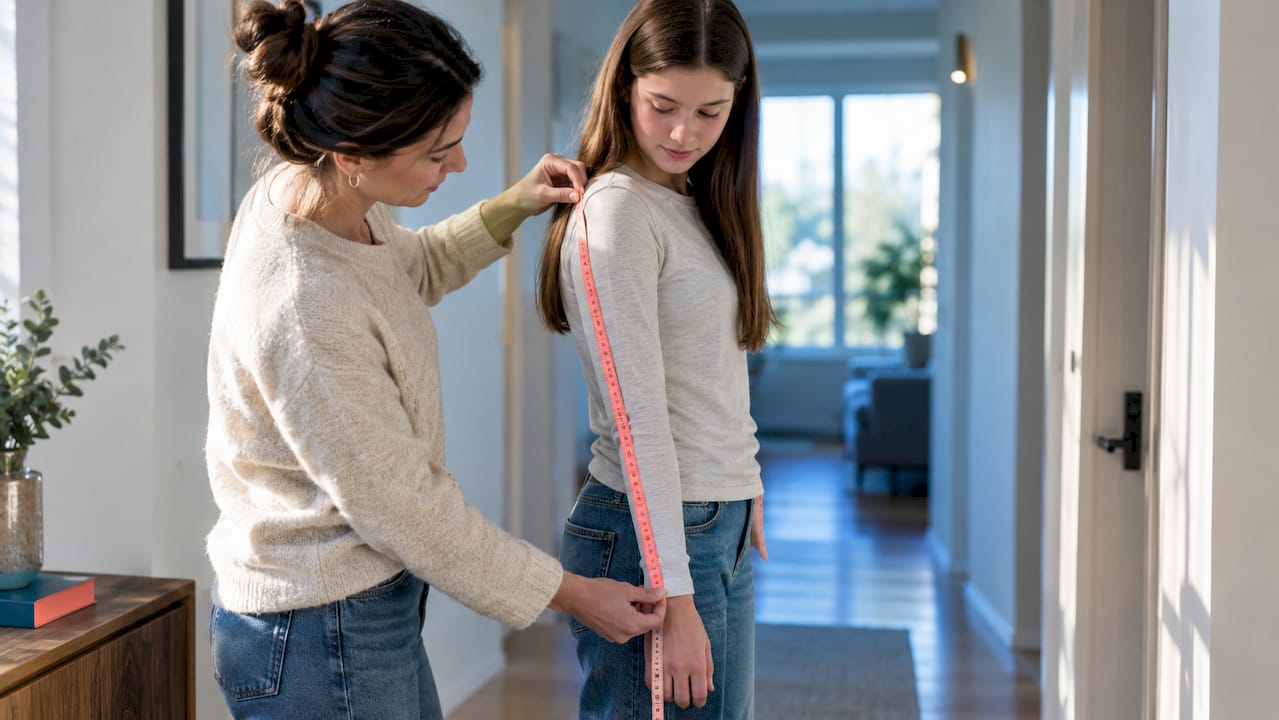
Skip the guesswork and grab a soft measuring tape, a wall, and about five minutes. Here’s the order that gets you the most accurate numbers with the least fuss.
Height. Have your teen stand straight against a wall with shoes off and heels touching the baseboard. Mark the top of the head with a pencil, then measure from the floor to that mark.
Chest. Wrap the tape around the fullest part of the chest, keeping it level and snug but not tight. Arms should hang relaxed at the sides.
Waist. Measure around the natural waist, which sits roughly at the belly button, not where jeans usually ride. Note the difference: pants sizing often uses the lower “pant waist,” a couple inches below the natural waist.
Hips. Wrap the tape around the fullest part of the hips and rear, keeping it parallel to the floor.
Inseam. Measure from the crotch seam to the ankle on a well-fitting pair of pants, or measure inside the leg from crotch to ankle bone directly.
The most common mistake is measuring over a hoodie or jeans, which can add an inch or more to every number. Keep the tape level around the whole body, not just in front. Loose tape gives a false small reading; a tape pulled tight gives a false small one too, so aim for snug contact with no compression. For a deeper walkthrough with photos, this step-by-step measurement guide covers the same five measurements in more detail.
Pro Tip: Take every measurement twice and round to the nearest half inch. Teens shift their posture without realizing it, and a second pass catches the difference.
Do Kids, Youth, and Adult Sizes Line Up?
Not cleanly, and that’s the part that trips up most parents shopping for a 13 or 14-year-old. Retailers run at least three separate labeling systems, and none of them were built to talk to each other.
Kids’ numeric sizing (7, 8, 10, 12, 14, 16) is what you’ll see on mass retail sites. Youth letter sizing (YXS, YS, YM, YL, YXL) shows up more on athletic and streetwear brands. Adult sizing (XS, S, M) kicks in once a teen’s measurements cross into that range, which happens earlier for height than it does for waist or hip.
A few real conversion examples make this less abstract:
A kids’ size 10 typically lands close to a youth medium.
A youth extra large sometimes matches an adult extra small in length, but rarely in waist or hip room.
A youth small (roughly ages 6 to 7 by label) can actually fit an 8 or 9-year-old who runs tall for their age, since the size is measurement based, not age based.
Slim-cut brands and boxier brands can shift chest measurements by roughly 1 to 2 inches at the same labeled size, so a youth medium in one brand’s cut can fit like a small in another. When a teen sits between two labeled sizes, check the specific brand’s own chart before assuming the universal conversion holds. This conversion guide breaks down more examples across kids, youth, and women’s systems.
Should You Size Up or Down for a Teen?
Size to whichever measurement matters most for that specific garment. Tops fit off the chest. Bottoms fit off the waist and inseam. Trying to average the two usually produces something that’s loose in one spot and tight in another.
A few situations call for sizing up on purpose:
Your teen is mid growth spurt and you want three or four extra months of wear out of the item.
The piece is meant for layering under a jacket or hoodie.
The fabric has no stretch, like raw denim or a structured button down.
The brand runs consistently narrow based on past orders.
Leggings and joggers need a snug waistband since stretch fabric hides a size that’s genuinely too big. Hoodies can absorb an extra inch or two of length without looking sloppy. Jeans are the one category where waist fit has to be exact, since a loose waist can’t be fixed the way a loose hemline can.
When something arrives, run a 30-second check: shoulder seams should sit at the edge of the shoulder, sleeves should hit the wrist bone, the waistband shouldn’t dig in when seated, and hems should clear the shoe without pooling.
Pro Tip: When a teen’s measurements fall between two sizes, size to whichever number carries the most weight for that garment, chest for tops, waist or inseam for bottoms, rather than splitting the difference.
Photo-Based Sizing as a Backup to Manual Measuring
Not every teen will stand still for a tape measure, and that’s the exact gap This tool was designed to close this gap: upload two photos and it generates a size profile without a single manual measurement, then lets you save that profile alongside profiles for other family members. Next time you’re shopping for your teen or their younger sibling, the sizing work is already done.
The practical upside shows up at checkout. A saved profile filters product results down to items likely to fit, which cuts down on the back and forth of ordering two sizes and returning one. It’s especially useful for repeat purchases from the same brand, since you don’t have to re-measure every time a teen orders another hoodie or pair of jeans. Manual measuring still makes sense for a one-off purchase or when you want to double check a brand’s chart directly, but for ongoing family shopping, a saved size profile tends to save more time than it costs to set up. Try the Free Size Tool to see where your teen lands.
How Do Sizes Track With a Teen’s Age?
Age labels on packaging are the least reliable number on the tag, and it’s worth knowing why before you shop by birthday instead of measurements. A size 14 is meant, loosely, for a 14 year old, but growth rates vary so much during adolescence that the label barely functions as a guarantee.
Early teens (roughly 11 to 13) sit right at the edge of youth sizing, often landing in youth medium to large depending on whether they’ve hit a growth spurt yet. Mid teens (14 to 16) usually move into youth large to extra large, and this is the age range where kids most often bridge into adult small sizing, especially in height and inseam, while still needing youth cuts through the shoulder and chest. Older teens (17 to 18) frequently fit adult small to medium across the board, particularly once their shoulder width and torso length catch up to their height.
The safest approach treats age as a rough starting point and nothing more. Two 14-year-olds can differ by four inches in height and two full clothing sizes, which is exactly why comparing height and weight against a brand’s actual chart beats shopping by the number printed on the age label. If your teen has always run tall or small for their age, expect that pattern to carry into how they size in youth and adult ranges too.
Why Do Brands Size Teens So Differently?
The same labeled size can fit two different ways depending on where the brand designs its patterns. A youth medium from an athletic brand built around performance fits and a youth medium from a fashion focused retailer can differ by an inch or more through the chest and shoulders, even though the tag says the same thing.
Regional differences add another layer. US youth sizing tends to run on the letter and numeric hybrid system covered earlier. UK sizing for teens often shifts to age based labels (like “13 years” or “14 years”) that correspond to specific height and chest ranges, but those ranges don’t match US numeric sizes one to one. EU sizing for teens frequently uses height in centimeters as the primary label, sometimes paired with a numeric size, which means a EU 164 (built around a 164 cm height target) requires a straight centimeter to inch conversion before it means anything on a US chart.
Athletic brands, including Nike and Under Armour, tend to cut closer to the body with performance stretch fabric, so their youth large can fit snugger than a youth large from a brand making cotton graphic tees. Boxier streetwear brands run the opposite direction, sizing generously through the chest and shoulders to accommodate a looser silhouette.
The practical takeaway: don’t assume a size carries over from one brand to the next, even within the same country. Check the specific brand’s chart, especially for a first order, before assuming last season’s youth large from a different retailer will fit the same way.
How Do You Plan Sizing Around a Growth Spurt?
Teen growth doesn’t move in a straight line. It comes in bursts, sometimes two or three inches in a matter of months, followed by long stretches where almost nothing changes. That pattern makes exact sizing genuinely hard to plan around, but a few habits reduce the number of items that get outgrown in a single season.
Buying one size up on non-stretch items, like structured jackets or raw denim, buys extra months of wear without the garment looking obviously oversized on day one. Stretch fabrics like leggings and athletic wear are more forgiving already, so sizing up there tends to just produce loose, sloppy fit rather than longer wear. Parenting and apparel guidance consistently recommends sizing up specifically for growth spurts, layering, and non-stretch fabric, while keeping true-to-size sizing for anything with real stretch.
Re-measuring every three to four months during active growth years, roughly ages 11 through 15 for many teens, catches size changes before they turn into a closet full of items that no longer fit. Outside of active growth windows, a measurement every six months is usually enough. Keep a running note of your teen’s measurements with dates attached. It turns “did they grow again?” into a two-second check instead of a guess, and it’s especially useful if you’re ordering online from a brand that runs on the smaller side.
What Fit Problems Come Up Most With Teens?
Teen bodies are mid transition, and off-the-rack sizing wasn’t built with that in mind. A few fit issues show up over and over.
Narrow shoulders relative to height is the most common complaint, especially in taller, leaner teens. A shirt sized to fit the chest correctly often leaves extra fabric pooling at the shoulder seam, since the chart assumes shoulder width grows in proportion to height, and for a lot of teens it simply hasn’t caught up yet. The fix is usually sizing to the shoulder and chest rather than height, and accepting a slightly shorter torso length as the tradeoff.
Longer torso relative to leg length is the flip side, common in teens who’ve had a recent height growth spurt concentrated in the trunk. Shirts that fit the shoulders ride up at the waist, and pants that fit the waist run short at the ankle. Buying tops one size up for length, and pants based on inseam rather than waist alone, addresses both issues without needing a full size jump everywhere.
Inconsistent proportions between chest and waist show up too, particularly in athletic teens carrying more muscle through the shoulders and chest than the waist chart assumes. When that happens, size tops to the chest and expect to size bottoms down or add a belt, rather than picking one size and hoping it works for both halves of the body.
What Parents Get Wrong About Teen Sizing
The biggest mistake isn’t measuring wrong, it’s not measuring at all. Most parents default to buying by age or by whatever size fit last season, and both habits ignore how unevenly teens grow. A kid can gain three inches in height and stay flat in the waist for a year, which makes an age-based purchase almost a coin flip.
The conventional advice to “size up when in doubt” isn’t wrong, but it’s incomplete without knowing which measurement drives fit for that specific garment. Sizing up a pair of jeans because a hoodie ran small is how closets end up full of ill-fitting bottoms. Fit is garment specific, not one universal number that carries across every category.
If there’s one thing worth prioritizing, it’s building a habit of re-measuring every few months during active growth years and keeping those numbers written down somewhere accessible. That single habit solves more sizing problems than any chart, conversion trick, or brand loyalty ever will. Tools that store this information for you, whether a simple note or a saved profile, remove the need to remember it all from memory every time you shop.
— admin
Skip the Tape Measure With a Saved Size Profile
This platform helps you find the right size faster than working through charts and conversion tables every time you shop for your teen. Upload two photos, generate a size profile, and save it right alongside profiles for every other family member, so the next order takes minutes instead of another round of measuring and guessing. It’s built specifically for parents juggling sizing for more than one kid, since siblings rarely wear the same size or fit the same brand the same way. Once a profile is saved, product results filter down to what’s actually likely to fit, cutting the return rate that comes from ordering blind. Head to the Free Size Tool and set up your teen’s profile before your next order.
Sources
FAQ
What Size Is Teen Size?
Teen size typically refers to youth sizing, which runs from XS to XL or numeric 5 to 18, based primarily on height and chest measurement rather than age alone.
Is a Youth Large 10/12 or 14/16?
Youth large most commonly corresponds to numeric 14/16, while 10/12 usually falls under youth medium, though the exact split varies slightly by brand.
Is Size 14 for a 14-Year-Old?
Not necessarily. A size 14 is loosely aimed at a 14 year old, but growth varies enough between individual teens that measuring height and chest gives a far more reliable answer than matching size to age.
What Size Is 13 to 14 Youth in Adults?
A youth size for a 13 to 14 year old, typically youth large to extra large, often overlaps with an adult extra small in height and sleeve length, but usually runs narrower through the waist and hips than true adult sizing.
How Can I Size a Teen Without Measuring Them Manually?
A photo-based tool can generate a size profile from two photos, which is useful when a teen won’t sit still for a tape measure or when shopping repeatedly from the same brands.